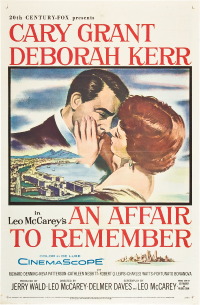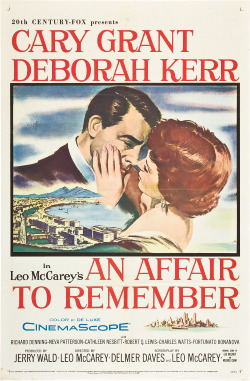
Review of An Affair to Remember (1957) by Ryan C — 13 Aug 2013
It was another lonely Saturday night. What to do, I thought to myself. Why, watch a movie, I happily reminded myself. Yes, but what? I turned to the dusty shelves of movies monopolizing my walls. "An Affair to Remember" caught my eye. Isn't that a bit... well... girly? I thought to myself. Yes, but maybe it will help mend your lonely heart. After all, YOU bought the damn movie! I begrudgingly put it on. Ten minutes later I was falling in love with Deborah Kerr.
"An Affair to Remember" has no doubt inspired countless romantic movies since it opened in 1957 ("Sleepless in Seattle," anyone?), and with good reason. Sometimes in Old Hollywood, characters fall in love with each other a little too quickly. It makes it less believable to an audience of today. But "An Affair to Remember" takes its time. And to some, that might be a bit boring, or too slow. But as you watch the love story unfold, you get swept up.
Director Leo McCarey (who took his own 1937 film "Love Affair" and remade it into "An Affair to Remember") is wise to stand out of Cary Grant's and Deborah Kerr's way - they've improvised quite a few scenes, and it adds to the realism. Their interaction is what keeps your attention. So by the middle of the movie, when Grant and Kerr go their separate ways (after having agreed to meet at the top of the Empire State Building in six months - if they still have the same feelings for one another), their interactions are severed and the movie's magic begins to unravel a bit. It doesn't help when McCarey has two (count 'em - two!) long scenes devoted to a children's choir singing forgettable songs. It couldn't get anymore hokier - until McCarey cuts to extreme close-ups of each awkwardly looking kid. Unbearable as these scenes are, once you "get through them" McCarey and co. reward you handsomely.
In the final scene, with Kerr confined to her couch on Christmas Eve (because, remember, she had been hit by a car while making her way to the Empire State Building on that fateful day - if only she wasn't, "looking up"), the music swells - and so do your tear-ducts. It's an ending you anticipate and, although it's a "happy" ending that only happens in Old Hollywood, it's the ending the movie (and we) deserve.
This review of An Affair to Remember (1957) was written by Ryan C on 13 Aug 2013.
An Affair to Remember has generally received very positive reviews.
Was this review helpful?