Review of American Pastime (2007) by Edith N — 09 May 2010
As you know, I like to glance at what idiots on IMDB have to say on various subjects. There's one over there--there's always one!--who has declared that huge amounts of the people interned in the camps [i]weren't even citizens[/i]. Which, of course, is true. Oh, huge numbers were, but yeah, a lot weren't. Of course, it was also the law at the time that those born in Japan couldn't become citizens. It didn't matter how long they lived here. It didn't matter how much they wanted to be. It was flat illegal. The person also says that not all Japanese-Americans went to the camps; didn't we know about the famous Japanese-American units in the Army? Which, of course, [i]also[/i] shows a lack of important information, as those units were raised from the camps. The guy claims that everyone in the camps was there because they refused to swear allegiance to the US. In short, it's amazing how ignorant people are of this time in US history. Jeanne Watatsuki Houston, for one, would be amazed at that statement, given that she was seven when she was put into the camp at Manzanar and not exactly given the choice. George Takei was five. His father was such an Anglophile that George is actually his birthname. Not exactly the action of a man passionately determined to fight for Japan.
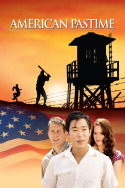
In early 1942, Roosevelt issued an executive order that sent all Japanese-Americans (except those in Hawaii, where it just wasn't feasible) to internment camps, mostly scattered across the West. Lyle Nomura (Aaron Yoo) had a baseball scholarship to college, but of course he can't go now--he has to go to Utah instead, to the Topaz internment camp. Conflict with his father, Kaz (Masatoshi Nakamura), keeps him off his father's team, though he shows up camp guard Sergeant Billy Burrell (Gary Cole), himself a former minor-league player--as was Kaz. Lyle also develops a love affair with Burrell's daughter, Katie (Sarah Drew), which of course drives every Anglo who learns about it crazy.
In fact, one of the people in the town, barber Ed Tully (Jon Gries), is adamant that the internees are responsible for everything. Burrell's son is killed in Japan, and it's the fault of "those people in there"--many of whom have never even been to Japan and have no concept of the country as anything more than Where My Parents (and even grandparents, in some cases!) Came From. Oh, there's almost certainly some loyalty there; I am interested in my family's Irish history, and I know a few people who are all but obsessed with their families' Scottish history. But if you asked these people to go to war with Scotland against the US, it just wouldn't happen. Having pride in where you come from, it turns out, is not the same as sabotaging where you are. Such was the case with the Japanese in the US, too--not one incident of actual sabotage by Japanese-Americans ever happened in the United States during the war.
Above a certain age, everyone playing someone in the camps was actually in the camps. Not the younger characters--not Lyle, his brother Lane (Leonard Nam), or Lane's girlfriend (Yukari Kama, who never gets a character name), obviously. But probably a lot of the extras, even. A few were born in Hawaii, and therefore probably weren't, and in fact the man playing the father was born in Japan in 1951. (He looks older.) But if you were Japanese or of Japanese descent on the US mainland in 1942, you went to the camps. It was really that simple.
The fact is, there was a lot of paranoia even before World War II. The bombing of Pearl Harbor was just a flashpoint to emotion that was already there. This film attempts to show how normal these people were--and they were, for the most part, normal. Just ordinary people in an extraordinary situation. But the fact is, if everything had been all ordinary for the Japanese-Americans, the internment would not have been possible on such a wide scale. People of German and Italian descent were mostly safe--this is in no small part because [i]huge[/i] amounts of the US population is of German descent--unless they actively espoused fascist views. But the Japanese looked different, and no one had ever trusted Asians in the US. (There was actually a constitutional provision in California that the vote was forbidden to "criminals, idiots, and the Chinese.") People like Ed Tully weren't made overnight. This film is trying to show us one relatively light aspect of those years, but it can't escape the racism entirely--it doesn't try to. Lane comes home from the war as an officer, and Tully won't give the man a haircut.
This review of American Pastime (2007) was written by Edith N on 09 May 2010.
American Pastime has generally received positive reviews.
Was this review helpful?