Review of Parting Glances (1986) by Edith N — 21 May 2013
A Day in the Life of Gay New York, Mid '80s.
It's worth noting that Steve Buscemi, who plays Nick in today's film, was not as funny-looking in 1986 as he has become. He wasn't conventionally good-looking. His facial structure is wrong for that. However, the oddities of his face weren't as prominent then. It's an interesting choice of casting, given that Nick is specifically referenced as a twinkie at one point. This is and was gay slang for a young, pretty man. I don't think Steve Buscemi was ever pretty. The potential attraction to him is that he is interesting. This is true of the character, though we can't be sure how different he had become since his diagnosis, and it seems, from what I've read, to be true of the real person. Not that I know very much about Steve Buscemi the person. But I think, if it weren't for that one exchange in the film between Nick and pretty-boy-whose-name-I-don't-remember, I never would have thought about it.
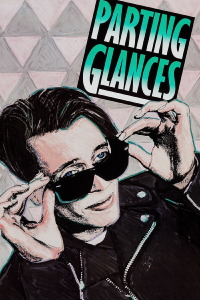
Robert (John Bolger) has a job that's going to send him to Africa. This means leaving behind his lover, Michael (Richard Ganoung). This might or might not be a break-up; neither of them seem quite sure. Rather than let them have their last day together, everyone they know seems to expect a bit of time with Robert as well. They have dinner at the home of Cecil (Patrick Tull) and Betty (Yolande Bavan), who are married even though it seems to me that Cecil is gay. From there, they go to a party at the apartment of Joan (Kathy Kinney, who went on to play Mimi on [i]Drew Carey[/i], so that's where you've seen her before), which is full of friends and people that Joan has picked up somewhere. Adding to all this strain is the fact that, while he may be together with Robert, Michael is in love with Nick. But Nick has AIDS and is obsessed with the thought that he's dying, which is not an unreasonable reaction to being diagnosed with the disease in the mid '80s.
Several of the characters express their level of discomfort with seeing Nick, and that's understandable, too. Nick is a symbol of what could happen to them, as they all know. He stopped risky behaviour as soon as he found out it was risky, but it was too late. A disease with an incredibly long incubation period will catch some people out no matter how they change, because it's always possible they haven't changed the right way soon enough. Nick didn't. It isn't much discussed, but it wouldn't surprise me if he were incredibly angry about the whole thing. It must not seem fair, because he did what he thought was going to save his life. He also resents the idea that people are working to develop drugs for the disease too late for it to do him any good, which is also fair. I know a couple of people with the disease who have lived longer with it than Nick could be expected to, simply because these people were diagnosed considerably later. Even ten years made a huge difference; remember, Magic Johnson is still alive.
I understand that Michael doesn't want to get involved with Nick because he doesn't want to face the fact that Nick is dying, and that's fair. That's completely understandable. However, what I don't understand is why he and Nick didn't get together before Nick found out that he was sick. Heck, I don't understand why they didn't get together pretty much right away. I'm not going to say it would have saved Nick's life; it's possible that he got infected before he ever met Michael. And arguably, if he had been, it probably would have killed Michael, a grim truth that both have probably considered. However, leaving illness out of it, it strikes me that the pair could have had a great relationship. Certainly better than Michael and Robert. I think Nick knows it now, and regrets what could have been and isn't, but I really wish I understood it a little better. It's one of the places the film fails--it never makes me understand.
One of the things I'm catching up with as I go is the history of gay cinema. This isn't just catching subtext in mainstream films, which is its own kind of game. (Check out [i]The Maltese Falcon[/i] some time!) This is seeing movies that are made by, for, and about gay people, portraying them on their own terms. The media of subcultures would make its own interesting study, I think. There are a lot of American subcultures that have produced a large body of film worth investigating, and I'm not sure most people know that. Too many people think American film begins and ends with big-name Hollywood studio pictures, and there's a wealth of independent film to explore. Independent film became a huge thing in the '90s, but it existed for decades before then. Yes, all right, probably the best-known independent filmmaker from before that era is Ed Wood, but there's also Roger Corman--and a lot of actually good filmmakers. Heck, the history of independent black films goes back to the silent era!
This review of Parting Glances (1986) was written by Edith N on 21 May 2013.
Parting Glances has generally received positive reviews.
Was this review helpful?