Review of Picnic at Hanging Rock (1975) by Edith N — 13 Jun 2013
Makes More Sense Without the Last Chapter.
This is not based on a true story. There are some people who think it is, but they are wrong. Hanging Rock is a real place, but the movie is based on a novel, and the novel isn't based on a true story, either. This means that all the clues about what happened to the women in the story must come from the book/the movie. As it happens, there is a final chapter which did not appear in the published novel, because everyone concerned decided that the story was more powerful without it. This is definitely the case, if what I've read about it is correct. (I haven't read it, but then, I haven't read the rest of the book, either.) The ending that appears in that final chapter is frankly silly. Leaving the ending a mystery--more accurately, I suppose, leaving bits of the middle a mystery--makes the story considerably more interesting. It doesn't do much for me either way, but if they kept the ending, I wouldn't like it at all.
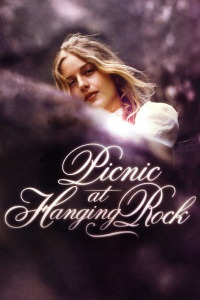
A group of girls are students at the private girls' school of Mrs. Appleyard (Rachel Roberts). The girls are celebrating St. Valentine's Day. As part of their celebration, Mrs. Appleyard allows them to go on a trip to nearby Hanging Rock. She does not allow Sara (Margaret Nelson) to go for reasons that I missed, but perhaps a dozen of the other girls go, accompanied by Miss McCraw (Vivean Gray) and Mademoiselle de Poitiers (Helen Morse). It is a hot, lazy afternoon, as befits a summer afternoon in Australia. Most of the girls drift off, and Miranda (Anne-Louise Lambert), Marion (Jane Vallis), and Irma (Karen Robson) get permission to explore the rock. Edith (Christine Schuler) tags along. Young Englishman Michael Fitzhubert (Dominic Guard) watches it all happen. Of the four girls, only Edith returns; Miss McCraw disappears as well. Eventually, Irma returns, but none of the others are ever seen again, and no one can figure out where they've gone.
It is a slow, dreamy film. Cinematographer Russell Boyd literally filmed with a swath of veiling over the camera to get the diffuse look he was seeking. There isn't a lot of story to the film. There is only the disappearance of the girls, Michael's determination to figure out what happened to Miranda, the conflict between Sara and Mrs. Appleyard. The point is the disappearance of the lost girls and how everyone responds to it. In many ways, the point isn't even what happened to the girls, which is why it's just as well that the last chapter was left off. And that's inasmuch as this movie has a point at all, which is only slightly true. Characters wander about the film, connected in ways I wasn't able to work out. I think it's probably better explained in the book, but as I said, I haven't read it. I'm not sure if the details on the Wikipedia page come from the book or the movie, either; there are one or two things that I don't remember as being mentioned that are kind of important.
I was talking to Graham today about Australian fiction set at the turn of the last century, and one of the points I made was that, depending on the location and class level, they can be almost indistinguishable from British fiction set at the same time. Obviously, it is easy to tell that this is Australia; the town of Woodend, Victoria, is a small one, and the geological formation is very different from that which you'd be likely to find in England. However, the girls get an allowance made for the heat--they are permitted to remove their gloves which actually on the picnic and away from anyone who might see the indiscretion. When Irma is returned, or is found, or whatever you want to call it, her corset is missing. Mrs. Fitzhubert (Olga Dickie) claims this is unimportant and therefore not worth mentioning to the police, which is completely ridiculous, but of course Irma would be ruined if words of the missing corset got out, and in this kind of society, that's far more important.
It's possible, if far from certain, that I would have liked this movie better if I had seen it in a different state of mind. I don't have the focus right now for the kind of ethereal piece this is trying for, and that means I'm less inclined to see the beauty of it. And it is pretty enough, in that rugged Australian kind of way. However, I didn't find it particularly interesting. This is the hazard of movie-watching on any kind of schedule. Unless you are exclusively watching what you are in the mood for at any given moment, the mood you are in will change what you think about things. I am tired, overheated, and restless. This means that meandering, moody pieces without much plot are lost on me, even if everyone else thinks they are Classics of Australian Cinema. And it's not as though Australian cinema is exactly normal at its most coherent, after all. It's not Japan, but there's something about those great sweeps of landscape and that isolationist heritage and so forth that produces some decidedly odd movies.
This review of Picnic at Hanging Rock (1975) was written by Edith N on 13 Jun 2013.
Picnic at Hanging Rock has generally received very positive reviews.
Was this review helpful?














![[REC] (2007)](https://cdn1.cinafilm.com/static/img/movie/5996792e/200/1-rec-2007.jpg)