Review of All That Heaven Allows (1955) by Levi S — 22 Jan 2009
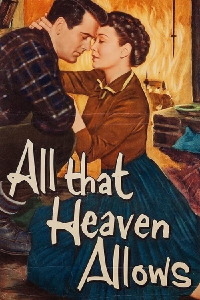
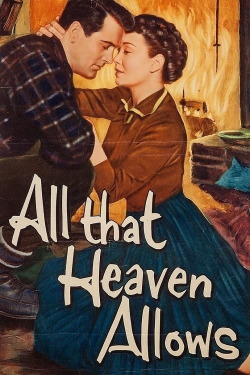
The fictional town of Stoningham, New England, the 1950s. Cary Scott is a recently widowed middle aged woman. Her children away at college, Cary is gradually returning to a social life after the death of her husband. She attends a dinner at the country club with an older man named Harvey. Soon after, Harvey proposes marriage in a rather unromantic fashion, assuring Cary she will feel the same. A young gardener named Ron is undertaking maintenance work on Caryâ??s garden and they strike up a tentative relationship before he disappears at the end of Autumn.
Caryâ??s children suggest a television set would make a useful companion for her. Ron soon returns and invites Cary to visit his friends who have escaped the rat race and live a more contemplative lifestyle, much different to her social circle. Ron asks Cary to marry him but Cary hesitates, considering it impossible. A local gossip, Mona, sees the pair and spreads gossip about them across town. Caryâ??s children are appalled by the idea of this marriage. Cary and Ron attend a country club function together, which ends disastrously as they are the victims of constant sniping. Cary chooses her children over Ron but Caryâ??s daughter soon convinces her to reunite with Ron.
Sirk had enjoyed a successful theatre background in Germany before emigrating to the US but took well over a decade to make his mark in Hollywood. Between 1954-1959 he directed a series of lavish melodramas in Technicolor, including â??Magnificent Obsessionâ??, â??Written on the Windâ??, a remake of â??Imitation of Lifeâ?? as well as the film in question here. The critical receptions for these films at the time were mostly negative, citing lack of realism and banal subject matter. However in recent decades Sirkâ??s films have been rehabilitated by critics and have influenced a series of important film makers. The premise of â??All That Heaven Allowsâ?? has been referenced by both Rainier Werner Fassbinder (â??Fear Eats The Soulâ??) and Todd Haynes (â??Far From Heavenâ??). Both films added a racial dimension to indict the society they were critiquing but â??All That Heaven Allowsâ?? is just as significant and powerful as the films it influenced in its social commentary. The critics of the day only viewed Sirkâ??s films as trivial and disposable weepies; the satire is subtle and perhaps required a degree of hindsight to be really appreciated.
Far from being a valid criticism, the artificiality of Sirkâ??s melodramas is actually one of their greatest strengths. Sirk wasnâ??t reflecting American society as the audience wanted to see it, in its white picket perfection, but instead he was reflecting it in a slightly distorted fashion with the dark side of the American dream. Itâ??s easy to take this for granted nowadays when films like â??American Beautyâ?? et al dissect the mores of the American middle class with great precision, but at the time films like â??All That Heaven Allowsâ?? were genuinely groundbreaking. Sirkâ??s aesthetical approach, encompassing his use of colour, lighting and framing set his films apart from anything else produced at the time and reflect his satirical objectives.
The opening shot sets an ominous tone. Sirk employs a birdâ??s eye view of the community. Everything is perfect, a typical suburban street with every house lined with trees in Autumnal colours. This is all surface, a pretence of everything being normal. The interiors of Caryâ??s house with its imaginative tones of colour reflect the confusion at hand; the cool blues of her room and the strong reds of the lounge for instance. Perhaps these reflect the contrasting emotions of Cary in the aftermath of her husbandâ??s death, torn between mourning and moving on. Sirk also employs innovative use of his camera, constantly tracking Cary during her first visit to the country club, but also with intense close ups when it matters. The most notable of which is after Ron and Cary have their first meaningful conversation. She asks about a specific tree; he tells her its a symbol of love and can only live where love exists. Sirk then zooms in on the tree - a sign of what is to blossom between the pair. The symbolism which Sirk uses can often be heavy handed though; a roaming deer is present during their first kiss and also when they are finally reunited.
The observations of American society however are spot on. The country club, the embodiment of bourgeois aspiration is presented as a hothouse of snobbery, gossip and backbiting. Women are willing to undermine their friends at any opportunity, whilst the men are lecherous. However despite knowing all this, Cary still wants to be part of this social circle. Opting out or being ostracised is a far worse prospect. This â??keeping up with the Jonesesâ?? mentality is contrasted with the more carefree attitudes of Ron and his own set of friends, who have retreated from the rat race and have a new outlook on life. This group is also far more diverse than the homogeneous set of friends Cary has. Ronâ??s friends encourage his relationship with Cary, whilst her friends and family believe the best form of companionship for her is a television set. Their prejudices become more obvious the more serious the relationship becomes, most notably from Caryâ??s children who make clear their shame and how this relationship with ruin their lives and reputations.
Jane Wyman and Rock Hudson had previously starred together in Sirkâ??s â??Magnificent Obsessionâ??, which was the first of Sirkâ??s classic melodramas (based on the myth of Alcestis). They donâ??t make the most convincing of couples and their relationship in the film seems to literally occur overnight and feels as if it lacks substance. But then as we established, realism wasnâ??t on Sirkâ??s agenda. The relationship exists as a device in order to critique the American middle class. In this respect Sirk succeeds with flying colours - his satire is subtle and sophisticated. Itâ??s visually that â??All That Heaven Allowsâ?? impresses most though; its exaggerated colour palette reflects the thoughts of its protagonists and the use of the camera remains inventive and thoughtful. Sirk would subsequently make better films; â??Written on the Windâ?? and â??Imitation of Lifeâ?? but this is a wonderful example of the Sirk melodrama.
This review of All That Heaven Allows (1955) was written by Levi S on 22 Jan 2009.
All That Heaven Allows has generally received very positive reviews.
Was this review helpful?