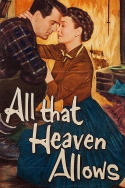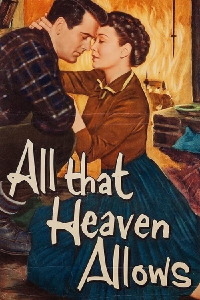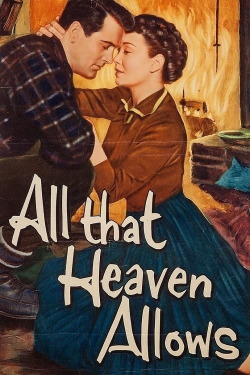
Review of All That Heaven Allows (1955) by Michael M — 15 Jan 2014
All That Heaven Allows is a film about love's ability to transcend social barriers. In this film there is no antagonist but society itself. The main character must struggle not only with the close-minded community she lives in but also with the traditional values and prejudices within herself.
Jane Wyman plays Cary Scott, a widow with two children in college. She is a lonely woman but not desperate. This fact is provided by Wyman's subtle yet powerful performance. When Harvey, Cary's friend and potential husband, purposes marriage he tells her, "I am not very romantic or impetuous but you'd hardly want that sort of thing". Wyman says nothing in response but conveys so much with a sad, defeated look that we know romance is exactly the sort of thing she needs.
Early in the film Cary meets Ron, a gentle, transcendentalist gardener played with rugged softness by Rock Hudson. His earthy nature and simple philosophy of living life on your own terms intrigues Cary. However, something inside her hesitates. After all, he is the gardener and a good deal younger than her. What would the neighbors say?
Ron and Cary's love blossoms ironically juxtaposed by the natural setting's transition from fall into winter. The course of true love never did run smooth and soon Mona Plash, the local gossip, has the whole town in an uproar. Cary's best friend Sara, (Agnes Moorehead) acts as a fulcrum between Cary's shift toward independence and the conservative upper class suburban obtuseness of the town of Stoningham, (a name which brings to mind swift puritanical justice). Sara's scenes act as a reminder to the audience of the outside pressure on Cary.
The attacks on Cary's aberrant behavior come from all sides. Even her own children despise her new found love or at least what it means socially. This leads Cary to an inevitable climatic moment when she most choose between true love or conformity.
The film's social message is quite overt. In fact, half way through the film Cary picks up a copy of Walden by Henry David Thoreau and actually verbalizes the main theme, "If a man does not keep pace with his companions because he hears a different drummer, let him step to the music he hears..." A simple message and one echoed throughout the film. Cary's greatest challenge is learning this lesson, "It should be so simple, two people are in love and want to be married. Why is it so difficult"? She learns that it is difficult because society constantly pressures you to fit in, something she had no problem doing in her former life when she was married to a successful businessman.
The 1950's were a strange time in American history. While Middle America was desperately trying to hold on to traditional values, social change was occurring. This film promoted such change. Today, in our modern world, Cary would simply be teased and referred to as a Cougar. Perhaps, a title she might embrace. However, I am sure there are still people just as closed-minded today as they were back in Stoningham.
All That Heaven Allows is a remarkable film. Visually, the Technicolor is vibrant and lush. Thematically, the story is at times far-fetched but so stirring and enveloping that anyone with a heart will be swept away. The music is sentimental but fits perfectly for this swelling melodrama. The acting is superb, especially Wyman's subtlety. Finally, the message of love against all odds makes for a gripping story and a social message just as strong today as it was back then.
This review of All That Heaven Allows (1955) was written by Michael M on 15 Jan 2014.
All That Heaven Allows has generally received very positive reviews.
Was this review helpful?