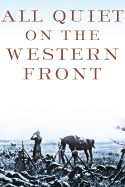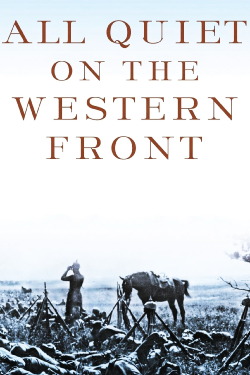
Review of All Quiet on the Western Front (1930) by Lee A — 28 Aug 2009
In its straightforward ways, the film All Quiet on the Western Front touches on the age old question of war: Why should they send us out to fight each other? If they threw away these rifles and these uniforms you could be my brother..., Lew Ayres' character Paul Baumer speaks to a foreign soldier he has killed. He's saying we are human beings, who happen to be in opposing countries that want us to kill each other... and why? The film asks, when you get right down to it, why is there even respect for it, for the fact that their might be 25,000 men being killed in one day, all in the name of strategy? And they're replaced like any other commodity in war - guns, bullets, tanks. People are sacrificed for the strategical will to win, to control, to take over.
The dialogue feels static now, but is still powerful and meaningful in its sentiment. The film is even more magnificent in its visuals of war and the middle war scene where the camera matches the visual rhythm of the machine gun and its victims is an unholy and arresting sight. We follow one pair of boots as it goes from one young soldier, to another, and another, with each owner being killed. We see Paul spend the night in a bunker with the man he killed laying in front of him. We see young, unadulterated kids, looking wide-eyed and eager at the soldier they see before them, only wanting to emulate his every move and wear his uniform and then rail against the truth of the battlefield he speaks to them. We see the higher ups sit around the table and laugh and argue over strategy, while have no understanding of the front lines. And we hear the bombshells piercing in the battlefield scenes; they are so sharp, so loud, it's like they're crashing right around us. But we also see light moments, of camaraderie among the men, and the enjoyment these German soldiers take in some French farm girls, and some touching moments, where the light at the end of Catholic hospital corridor turns from darkness to sunlight. The film may be a bit rough to look at, but it fully encompasses the soldier's experience, has truly great camerawork, some brilliant cinematography for such an early film, and Lew Ayre's leading performance is stupendous.
The film's final two scenes: of a soldier reaching for a butterfly and being killed, and a shot of infantry soldiers looking back while they march superimposed over a shot of gravestones ring in the final haunting notes of the film.
In my opinion, this film is saying the same thing that Wilfred Owen's poem Dulce et Decorum Est does, that while war is a necessary evil man sees fit to use, it is not the beautiful thing it is shown to be at times. It is not something to be glorified and made beautiful just to recruit young soldiers, but is more like horror show filled with gore, death, and sadness that rips apart men's bodies and psyches. Its story's path refused to follow the conventions of the time, and thus it stands among the great films in its genre, as well of all film, and holds up just as strongly today as it did almost 80 years ago. Its scope, both on the battlefield and in the human mind has hardly been paralleled since.
This review of All Quiet on the Western Front (1930) was written by Lee A on 28 Aug 2009.
All Quiet on the Western Front has generally received very positive reviews.
Was this review helpful?