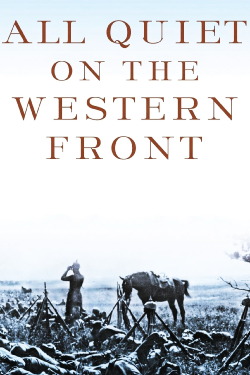
Review of All Quiet on the Western Front (1930) by Edith N — 23 Sep 2010
It's Easy for the Men Who Have Never Seen the War.
I cannot help wondering how many people who have seen this movie did so because of a history teacher. I have vague memories of having seen this because of my beloved Ms. Downhower. It would have been freshman year. World history. I don't know quite when it would have been. I still have the notes for [i]Ben-Hur[/i], which might have been the final for fall semester, so this might have been the final for spring. (She didn't actually make us take a final, as I recall, because we had an enormous project instead.) However, since all I really remember is that infamous shot of the shadow of a bedstead, I couldn't say for sure. It's only by process of elimination that I'm sure it was in her class. It was all a very long time ago, after all, and she's been dead for more than ten years. Not that I like to think about that.
It is 1914. As happened across Europe and in Canada, young men are being urged by old men to run off to war. Paul Bäumer (Lew Ayres) is the unofficial leader of his class, and so Professor Kantorek (Arnold Lucy) puts particular pressure on him to leave school and join the army, because he knows the other boys will follow. It works, and so his class all go off to war. Their first rude awakening comes before they even get out of training. It's not so lighthearted as they imagine it would be, an image of the military I've never understood. They're stunned at actually being expected to follow orders, which I thought everyone knew was a basic requirement of being a soldier. Their next rude awakening comes when war turns out to actually involve getting shot at. And getting shot at actually involves being wounded or even dying. And one by one, they do just that. They die or are crippled beyond the ability to carry on or, at least one of them, go mad. In the end, Paul has watched the boys he led to war die more times than any man would want to.
This movie did not make people happy upon its release. To put it mildly. The Nazis were not yet in power in Germany, but they did everything they could to disrupt showings--and when they did come to power, they banned it. The Polish government banned it for being pro-German. In the United States, it only made the isolationist movement that much more determined; Ayres himself was a conscientious objector during World War II because of his experiences in the making of this. After all, as I've said before, World War I was a stupid war. The tactics were stupid fifty years before. As the war progressed, more and more tools of destruction were invented. The movie does not, as I recall, show anyone using gas, but tanks are referenced and an airplane features in a major scene. Basically, what the movie did was remind everyone of all of that. Paul cannot be a recruiting tool because he knows what it's really like out there, and a lot of people either wanted to pretend it wasn't like that or else use the fact that it was to their own advantage.
One thing which might slip past viewers of the film is that all of those boys were in the same unit. Some people who do notice it might assume that it's a storytelling convention, the economy of character concept. We've invested in these boys, and it's simpler than creating all sorts of other characters. One of the tools of the American war movie is the bringing together of boys from all across the United States. Why, then, the difference here? And it's because, at the time, you pretty much did end up in the same unit as the people with whom you went to the recruiting station. George talks about it in [i]Blackadder Goes Forth[/i]. He recounts the tale of standing in line with his college chums, and he lists how they all died. In [i]Johnny and the Dead[/i], Terry Pratchett has his characters discover a unit from their hometown wherein only one survived the war. I'm pretty sure the US discovered the folly of such a tactic in the Civil War; it took World War I for the nations of Europe to learn it.
This film is brutal. Director Lewis Milestone worked so hard on accuracy that the Department of Sanitation shut down production long enough to do an inspection of the trench set. A man laying wire midway through the film did just that during the actual war; indeed, many of the extras and minor characters were German World War I veterans who had relocated to California, presumably to be somewhere warm and dry. Personally, I think the last scene is maudlin and overdone, but I can see how other people would be moved by the symbolism. Paul Bäumer has lived decades in the three years he spends at the front. He learns on his leave that this makes him different not just from who he was but from who all the other people are. The old men are still talking about the glory of war. They pore over maps and tell Paul what tactics would work. And then they tell him that he can't know how to do things right, because he's right there in it.
This review of All Quiet on the Western Front (1930) was written by Edith N on 23 Sep 2010.
All Quiet on the Western Front has generally received very positive reviews.
Was this review helpful?