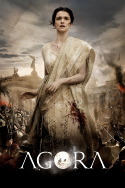
Review of Agora (2009) by Sergio E — 21 Apr 2011
An ambitious film that that needed a stronger director and a finely tune script to have brought to life the conflicts of the religious strife of the pagans and the Christians in order to full grasp the differences and complexities of both parties. We're not fully aware of the tension that both parties are under because the story jumps from too many plots that weights down the movie's narrative. Rachel Weisz does a tremendous job as the lead that is worthy of the Oscar talk she has gotten for her role but she and a great cast of international actors are left wondering by themselves with a script that just does not do their performances justice and a point of view by the director who just seems like he's trying to please both sides of the argument with out being brave enough to give an stronger look of that point in history.
If the director just focus his attention on Hyptia and made her more human ( its a real testament to Weisz's talent as an actress that she's able to make us care about the character at all despite the fact that the script does not help Weisz out) that this could have been a better film but as it is, its a worthy trip to the art house for the great acting alone, which saves this film from being a total failure. Alejandro Amenabar, has devoted an entire film to this story, and one can see that the subject fascinates him. How did we become who we are today? What was it that transformed the Roman Empire (the Western World, in other words) into the world of Jerry Falwell and Pat Robertson? Sure, the events happened more than 1500 years ago, but the link is clear as glass.
In a world which set design has rendered so believably that it might as well be taken directly from a wall painting from Pompeii, and populated by characters so well cast (at least physically) that they might, as one reviewer has already said, come from Greco-Roman mummy portraits from Roman Egypt, particularly Davus, the slave boy (Max Minghella) and Ammonius, the fanatic (Ashraf Barhom), the civilization of the Hellenistic world is coming under attack by the forces of an intolerant form of Christianity, which seeks to "purify" the city of Alexandria. Hypatia, however, dispenses with religious distinctions in her classroom, teaching pagans, Christians, and Jews alike the secrets of the universe. Her earnest pursuit of scientific truth trumps all other preoccupations, until, at the end of the film, she finds, to her horror and incomprehension, that her very existence on this earth has become impossible.
I have to say that I found the film very engrossing, but then, I love the period and am fascinated by the religious upheavals of late antiquity. I can say that all of the actors perform wonderfully, though I do wish the role of Davus had been fleshed out. Minghella is heartbreaking, and his role perfectly illustrates what it was that likely made many turn to Christianity. If only we could have seen more of him. At times, the film seems like his story, not Hypatia's, and he vanishes for most of the second half. I myself buy why Hypatia has so many suitors (Weisz makes her extremely intelligent without sacrificing physical beauty, and imbues her with a wide eyed, childlike quality that exudes vulnerability and innocence), but I think I needed to see her struggle with her demons more. Why does she reject Orestes? A single shot hints at a conflict here, but it is left at that. The film had an additional twenty minutes that were cut for the sake of marketability. . .perahps the director's cut will illuminate this more? To sum up, the film is flawed, too much character development is sacrificed for the sake of pacing, but in the end, it is an affecting film about a time period that needs to be better known.
Finally, a movie has been made that shows the loss of freedom of inquiry and of religious belief that took place in the late 4th Century early 5th Century C.E. (Common Era) as Christian fundamentalists took political power. We see how these fanatics ruthlessly attacked pagans, Jews, and secular philosophers who didn't follow the "true religion." It places well on the historic events that occurred in Alexandria, Egypt, at that time with brief mentions of what's going on in the rest of the Roman world, such as the edicts from the emperor. Rachel Weisz is brilliant as Hypatia.
The movie is also a great reminder of what happens when religious fundamentalists have their way. No freedom of religious belief or inquiry existed for hundreds of years in Europe while Christian clerics were in control. But we need only look at events today in Saudi Arabia and anywhere else in the Islamic world where Sharia law has been imposed to see the barbarism that unfolds. In areas of Afghanistan where the Taliban are in control today (2010), women are beaten or even executed for being outside alone or for getting an education. When the Taliban ruled the country in the 1990s, they also suppressed the teaching of math and science, and tried to wipe out the country's history through the destruction of records, films, and monuments. In Saudi Arabia, rape victims are whipped.
I'm sure there are some Christians who are uncomfortable with this movie's reminder about Christianity's early history. Fundamentalist leaders like Pat Robertson and Franklin Graham denounce the spread of Islam through conquest in the 7th and 8th Centuries. Yet they turn a blind eye to the tyranny and loss of freedom that occurred when Christians gained political power in the late Roman era.
Agora is quite a change from the old movies from the 1950s that had a religious overtone. Several of them, such as The Robe, Quo Vadis, and Samson and Delilah, depicted all pagans or anybody who isn't a Jew or Christian as morally depraved and decadent. Christians were always portrayed as good and pure. The focus was only on biblical-related stories that ignored the world outside the Bible. As far as they were concerned, nothing good came from pagan Egypt, Greece or Rome. Fortunately, movies of that nature aren't being made much anymore or are bombs at the box office.
It's a shame that Agora did not get much advertisement in the United States.
Alexandria, 391: Hypatia teaches astronomy, mathematics, and philosophy. Her student Orestes is in love with her as is Davus, her personal slave. As the city's Christians, led by Ammonius and Cyril, gain political power, the great institutions of learning and governance may not survive. Jump ahead 20 years: Orestes, the city's prefect, has an uneasy peace with Christians, led by Cyril. The Christians enforce public morality; first they see the Jews as their obstacle, then women. Hypatia has no interest in faith; she's concerned about the movement of celestial bodies and the brotherhood of all. What place is there for her?
This review of Agora (2009) was written by Sergio E on 21 Apr 2011.
Agora has generally received positive reviews.
Was this review helpful?