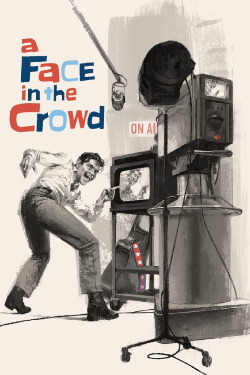
Review of A Face in the Crowd (1957) by Dave J — 20 May 2011
Elia Kazan made a different kind of movie in the 1950s. 'On The Waterfront', 'A Streetcar Named Desire', 'East of Eden'... his films were more than entertainment or a means of escape. Kazan made statements. His films told stories that illustrated a point; not an opinion, but a point. The story of the film argued that point as if in a debate.
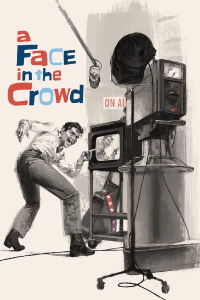
'A Face In The Crowd' argues strongly that there was a new tool - and perhaps a new evil - in the medium of television. An evil that invades the very household of almost every American on a daily basis. Evil because it can make anything, good or bad, look any way it wants. Good can be demonized and bad can be glorified. It is the mass-hypnosis machine and its innocent-looking facade is... well, anything but.
In "A Face In The Crowd", Kazan (along with writer Budd Schulberg,) tells the tale of a megalomaniac personality being slowly pulled out of the otherwise well-meaning, free-wheeling, good-ol' country boy hobo-turned superstar, Larry "Lonesome" Rhodes (an iconic screen debut performance by the great Andy Griffith before he headed over to Mayberry). The transformation into (or, perhaps, unveiling of) a greedy, power-hungry, "demagogue in denim" is a direct result of enough time in front of the camera eye and the public spotlight. It's a powerful comment on the influence of television and the new language of "public image" that has, since the film was made in 1957, become a multi-billion dollar industry in America and much of the world.
For example, beyond anything that could be done in any debate or speech, Arkansas Governer Bill Clinton clinched his victory over George Bush in the 1992 Presidential race by playing the saxophone on The Arsinio Hall Show - a scene taken almost directly from this film, in which a senator running for president appears on Rhodes' highly-acclaimed TV show and plays a cool and down-home caricature of himself for the cameras. (It worked out better for Slick Willy, but you get the idea.).
Patricia Neal plays Marsha, the proverbial Jiminy Cricket on Rhodes' shoulder that he simply never listens to. Her beauty and her honesty are indicators of her purity. When she's smiling at Lonesome, we believe in his goodness. When he makes her cry, we lose all faith in him. In this way, she is us - she is the American public being wooed and heartbroken, again and again, by what we think we're seeing on that screen.
The film poses a valuable central question; from whence does this evil come? Is Lonesome Rhodes an evil man? Is it our sense of worship of celebrity? Or is it the camera and the television itself? The concept of "public image" in opposition to any other image? Where did it all go wrong? And who's to blame? These questions would seem meaningless if the premise didn't feel so close to home. It's all true - we've seen it a thousand times. The television tells lies as often as it reveals truth. Is it an asset? Is it a disease? Is it all worth it?
The story of the meteoric rise and tragic fall of the celebrity of Lonesome Rhodes feels all too familiar these 54 years later. To realize it was made in 1957 - the era of television's infancy - is to recognize its prophetic genius and to respect its message: do not believe everything you see.
Walter Mathhau has a small, but important role in this film as the hopeful skeptic, and his character reveals a bittersweet message to our dear Marsha at the end.
"You were taken in, just like we were all taken in. But we get wise to 'em; that's our strength. We get wise to 'em.".
Save hope, America. In the end, we always get wise to 'em.
This review of A Face in the Crowd (1957) was written by Dave J on 20 May 2011.
A Face in the Crowd has generally received very positive reviews.
Was this review helpful?