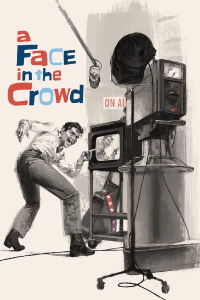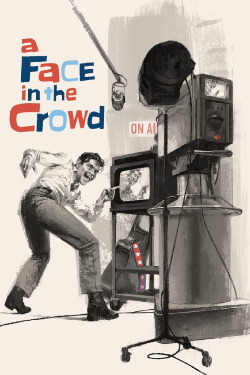
Review of A Face in the Crowd (1957) by Joshua C — 13 Nov 2017
If Network and The Doors had a baby, they'd make Face in the Crowd, send it back to 1957, and it'd be the masterpiece nobody talks enough about regarding the implications of capitalism, sensationalism, superficiality, and sexual obsession through commercialism. Who doesn't want to be all the devilish functions that are Lonesome Rhodes? I was really shaking my head and asking myself why am I such a balls-less person while watching the rise of Lonesome in all his glory - I wanted to be as cool and rebellious as this man.
Lonesome must be the voice behind Donald Trump, using words that reach the common people at first, but in actuality isolate him from the leadership people need. The politicians who align themselves with him "know what's best for the people," and Lonesome is willing to jump right on that wagon. But he wasn't always like this, he's far more complicated than that. In fact it was a fiery independent spirit that propelled him, never succumbing to the sponsors (like the mattress man) who paid him, thus empowering him over them - people would riot in his favor. Unlike Barry Lyndon, he's willing to take a backseat to success at first; rather be poor than kiss anyone's ass. But something clicks at a certain point, when he sees that he can influence powerful people, that suddenly he's willing to work with them. It starts off at Vitajax, where he pops these useless pills like candy, taking over the room with nothing but charisma, the suggestion they ought to be yellow, and ultimately the placebo to a hungrier sexual appetite, which is played out rather explicitly for a 50s film. The Marilyn Monroe girl selling the giant bottle at her bedside was priceless. From here, we suddenly see him happily selling products on his TV show, whereas before he was mocking them. He's getting a hell of a pay, and as he grows in success, shamelessly dotes on women, even though Marcia is his gal. But she is naïve to his playboy, even when he's chasing other girls in front of her. This attitude doesn't change until he shamelessly goes after a teenager in Betty Lou, which creates some reluctance in certain circles, but doesn't throw him out of the fold quite yet. He ends up marrying her deceitfully behind Marcia's back, who he'd just proposed to. And it's all downhill from here. Eventually he catches his manager and friend Joey sleeping with Betty, thus tossing her from his life, which results in a whiny teenage tantrum.
One of my favorite moments is the descent into Hell montage in which we symbolically watch the lights on the elevator take him down while intercutting with various sponsors and fans pulling out from the Lonesome camp. I laughed when he said , "take me down" - I didn't think the symbolism would carry any further. From here, Lonesome enters the murky depths of his own phony existence, succumbing to a completely detached from reality breakdown after learning that the world has heard his negative view of them when Marcia Jeffries left his microphone on through the end credits. He was bound to get to this point, a boy trapped in a man's body, anxious to feed his insecurities, hurting anyone along the way to do it, including the only person who ever really believed in him, loved him, and gave him the chance, Marcia. There's a terrific thunderstorm set moment when he cries in her lap and we see her acknowledge herself as the creator of this monster, a shadow coming across her face like Bride of Frankenstein. But her intention was good, to help someone who probably didn't have a real shot in life, and she does not deserve to take all the blame, nor will the film ultimately punish her that way. Lonesome is like David Lynch's Experiment, formed in a box (jail cell), let loose in the world, viciously causing damage to anything it comes before - and it was always just that, an experiment gone wrong.
I was initially reluctant to sit down and watch a movie in the middle of the day when this came on, despite it being an Elia Kazan film. I decided I'd watch the opening minutes, and if anything grabbed me, I would stay with it until I was slightly less interested. That's the magnetic power of Andy Griffith and Patricia Neal, two fiery ambitious, extremely attractive people. Griffith's electricity shocked me, as I know him to play much more low key roles with calm poise. And I couldn't stop looking at Patricia Neal, not beautiful in the bombshell way, but so much more obsessively intriguing, a more broken in face, a woman with experience, and yet the desire to be ever young in Lonesome's rebel fantasy.
This review of A Face in the Crowd (1957) was written by Joshua C on 13 Nov 2017.
A Face in the Crowd has generally received very positive reviews.
Was this review helpful?