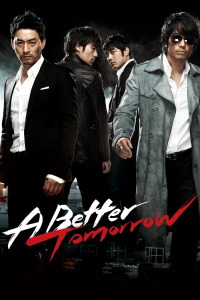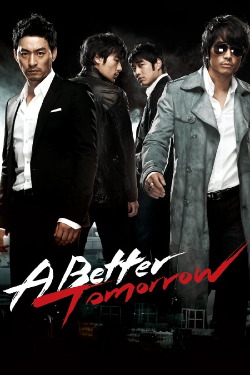
Review of A Better Tomorrow (2010) by Kegan C — 22 Jun 2007
In rolls the music- so daring and vibrant- catching the ear and pulling the soul along with it as the electric keys rise and fall in that royally stylistic way that can only suggest what greatness is about to follow. Ushered in by the humming notes, they stride- seeming to ride the rings of sound down the hallway like gods on chariots of synthesized glamour. Their classy suits and sport coats hang over them like the finest robes as their sunglasses reflect the world around them in a most ?other-worldly? fashion. The moment climaxes as Ho (Ti Lung) feels the breeze of counterfeit bills upon his face, and Mark (Chow Yun Fat) lights his cigarette on a ?One hundred?, inhaling the nearly tangible essence of everything that makes them ?cool?. Clearly, this world is theirs and we are to be but spectators to their glorious feats of undying style.
And so we are introduced into this universe that John Woo has created for us to observe, and if we are lucky, take a part of it with us. John Woo?s landmark ?heroic bloodshed? film, ?A Better Tomorrow? (?Ying Hung Boon Sik? 1986) opens up a doorway into a place where you never want your body to go, but wish that your heart could always stay.
When analyzing the films of John Woo (Wu Yusen), you will be faced with a raging torrent of moral explorations, global ideals, genre bending concepts, and countless evaluations of what makes us human. Yet the term ?heroic bloodshed? (though a single phrase will simply never suffice) appears with a blaring frequency that will not cease until it reigns as the sole idea that comes to mind when you imagine John Woo. The concept of ?heroic bloodshed? can be difficult to interpret on our own when referring to these films. This concept is often misconstrued by the dozens of visionaries and artists like us who try to make sense of these films which are arguably some of the most unique moments of fictional human interaction ever captured by a camera. The most direct route to interpreting the soul of John Woo will undoubtedly be through examining his characters, to whom Woo has given the honor of existing as cinematic images of himself.
However, the genius behind the camera was not the only one that gave ?A Better Tomorrow? its incredible charm and dramatic intensity. The heart of the film would be felt through the amazing efforts of it?s cast: Seasoned actor Ti Lung, famous for his countless lead roles in dozens of Chang Cheh films from Shaw Brothers Studios), pop-star and drama actor Leslie Cheung (who would go on to star in several films by world-renowned art-house director Wong Kar Wai) and of course the ?God of Actors? himself, Chow Yun-Fat. It was through ?A Better Tomorrow? that Chow Yun-Fat got his big break, launching him into super-stardom nearly over night. In fact, the jaw-dropping charisma exhibited on screen by Fat would grip the audiences so much, that youth around Hong Kong even began to dress and act like the cool, smooth-styled gangster after the film released in 1986. Though the climate was sub-tropical, teenage boys in Hong Kong wore long dusters in emulation of Chow's character. In fact, in colloquial Cantonese, trench coats are called "Mark Gor Lau" (literally, Brother Mark's coat). Chow Yun-Fat, after his legendary performance in the film, would go on to be John Woo?s ?main man?, and star as the lead in several of his later films such as, ?A Better Tomorrow II?, ?The Killer?, and ?Hard Boiled?. However, none of these films or any others like it in the newly conceived ?heroic-bloodshed? genre would have ever existed if it had not been for ?A Better Tomorrow?.
It should also be noted that the talent of Tsui Hark (director of classics like ?Green Snake?, ?A Chinese Ghost Story?, and ?The Blade?) also had a great part in creating ?A Better Tommorow?. Tsui Hark acted as Producer on the film and it?s sequel... and even went on to solely direct the third installment (which of course, without John Woo was never fully realized). Together, Hark and Woo collaborated to produce a work that not only gave birth to a new genre... but established them both as names that will forever be remembered in Asian cinematic history.
The dirt and debris ricocheting off the walls around the trench-coated gunmen, the agony in their faces as they watch their friends fall wounded... the fire in their eyes as they avenge them; these images will last in our minds and in our hearts forever. The original Chinese title of the film translates as ?Ying Hung Boon Sik? in Cantonese and as ?Ying Xiong Ben Se? in Mandarin... which basically means ?The True Color of a Hero?. And such is exactly what John Woo?s film displays; firmly establishing himself and his new genre as being so much more than a story of crime and guns... but a story of honor and friendship.
The dramatic soundtrack, at times both haunting and glamorous, gives an entirely new aspect of life to the film. Music undoubtedly has played a large part in establishing the over the top dramatic style of all of Woo?s films, and ?A Better Tomorrow? is no exception. The theme song of the film, ?Dong Nin Ching? is very famous throughout Hong Kong, and was even performed by the ?Four Heavenly Kings of Cantopop? (Andy Lau, Leon Lai, Jacky Cheung, and Aaron Kwok) at the memorial tribute to Leslie Cheung (who played ?Kit? in the film) after his untimely death.
Through Woo?s use of stylized camera movements and most of the action being shot in a gritty and glorious slow-motion, the film conveys a deep, genre-defying sense of emotion and attachment that separates it as a piece of true cinematic art.
?A Better Tomorrow? has meant many things for the world of cinema. The film imeadiately launched Chow Yun-Fat into stardom, giving us one of the greatest Chinese actors of all time. The movie?s success was also responsible for John Woo?s own rise to fame in the Hong Kong film industry, immortalizing him as the grand master of dramatic ?heroic-bloodshed?. ?A Better Tomorrow? continues to thrill and captivate film lovers today, and even made the # 2 spot in the Hong Kong Film Awards? ?100 Greatest Chinese-Language Motion Pictures of All Time List?... an incredible achievement!
?A Better Tomorrow?s? success launched countless waves of other triad films in Asia and still maintains it?s influence upon cinematic artists today, and though often imitated it has rarely been matched. Though John Woo?s other films may have surpassed ?A Better Tomorrow? in terms of visual style and action, there will never be a replacement for the film that started it all.
This review of A Better Tomorrow (2010) was written by Kegan C on 22 Jun 2007.
A Better Tomorrow has generally received positive reviews.
Was this review helpful?