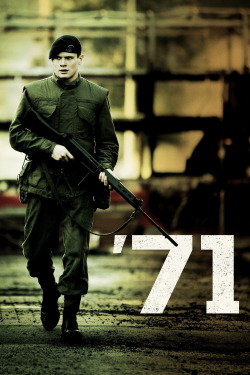
Review of '71 (2014) by Doctorfilm — 29 Mar 2016
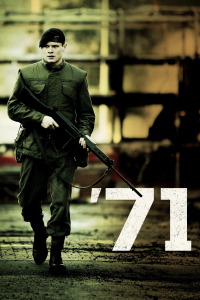
The Troubles have rarely been more troubling onscreen than they are in “’71,” a vivid, shivery survival thriller that turns the red-brick residential streets of Belfast into a war zone of unconscionable peril.
Demange’s film premieres in the Berlinale competish 11 years after Paul Greengrass took top honors at the fest for “Bloody Sunday,” a docu-style chronicle of the 1972 attack on Irish civil-rights protesters by British troops that remains, for many, the benchmark for all cinematic depictions of this brutal chapter in history. Taking place — as the overly loose-fitting title implies — one year before that landmark tragedy, the fictional “’71” is obviously comparable to Greengrass’ film in terms of subject matter, and may well have a similarly jump-starting effect on its talented helmer’s film career. Stylistically and even politically, however, it’s a very different beast: Tactile and expressionistic rather than journalistic, its initially opposing British perspective blurring amid the carnage, it’s effectively a horror film with a strict historical pretext.
Its narrow timeframe and juddering shootout finale notwithstanding, in fact, “’71” calls no film to mind so much as Roman Polanski’s Holocaust drama “The Pianist” in its dramatic defamiliarization of urban space, and its tight focus on a single character’s sensory experience of his surroundings amid broader conflict. Chris Oddy’s remarkable production design makes a surreal warren of blind alleys, bombed-out corridors and once-domestic deathtraps from the modest terraced houses of the Northern Irish capital — a nightmare videogame environment with real blood and no replay option. (The pic was undetectably shot not in Belfast, but in architecturally equivalent Liverpool.).
O’Connell plays new army recruit Gary Hook, a teenaged orphan with a kid brother (Harry Verity) still in the bleak children’s home where he himself grew up; military service, it seems, is his only route to self-sufficiency. Expecting a cushier first assignment, Hook and his platoon are surprised to be deployed immediately for emergency peacekeeping in Belfast, riven by friction between Protestant Loyalists and Catholic Nationalists — the latter themselves divided between the IRA and more radical dissidents. The lean, laconic script by Gregory Burke (who effectively explored soldier psychology in his award-winning stage play “Black Watch”) keeps the establishing politics simple; it’s the ambiguities in personal allegiance that propel the plot into denser, double-crossing territory.
After a routine house raid in the Catholic part of town goes awry, with the troops unequipped with riot gear, Hook’s unit beats a hasty retreat from the violent assembled crowd — so hasty, in fact, that Hook and fellow soldier Thommo (Jack Lowden) are unwittingly left behind. Thommo is shot dead by two IRA youths; Hook barely escapes into the backstreets. What ensues is a disciplined but many-angled manhunt tale, as the missing soldier is simultaneously sought by his commanding lieutenant Armitage (Sam Reid), his IRA attackers and the Military Reaction Force, a covert intelligence branch of the British Army fearful of what Hook may learn the longer he spends in the wrong part of town. Questionably helping hands are offered along the way by a Catholic ex-army medic (Richard Dormer) and a foul-mouthed pre-teen Loyalist (Corey McKinley, a marvelous find).
The film sounds plottier on paper than its proves in practice, where complex internal politics take a back seat to the protag’s in-the-moment experience of these hellish events. This odyssey is rendered alternately ambient and viscerally immediate by Tat Radcliffe’s extraordinary widescreen lensing, which switches between 16mm for daytime sequences and digital as darkness falls, the accompanying shift in texture reflecting Hook’s fluctuating consciousness. Remarkable sound work similarly alternates between crisp clatter and dreamy, shellshocked distortion.
If the film’s tech contributions play an invaluable role in letting audiences into Hook’s head, it’s O’Connell’s sturdy, humane performance that keeps them there. As also demonstrated in David Mackenzie’s prison drama “Starred Up,” he’s a ferocious physical performer, possessed of a hard-bitten masculinity not overly common in his generation of leading men. (That he’ll be seen later this year as Olympic athlete and WWII hero Louis Zamperini in Universal’s Angelina Jolie-directed biopic “Unbroken” is a factor international distributors may take into account when selecting a release date for this arthouse effort.) Yet it’s the vulnerability and palpable panic O’Connell conveys in Hook that impresses most — for all his strength and resilience, the audience is never allowed to forget that he’s little more than a child soldier.
This review of '71 (2014) was written by Doctorfilm on 29 Mar 2016.
'71 has generally received very positive reviews.
Was this review helpful?