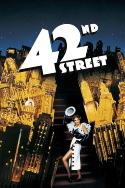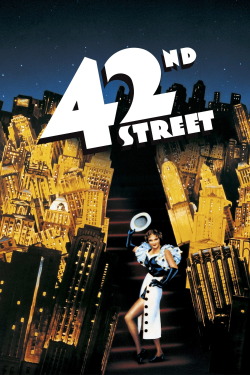
Review of 42nd Street (1933) by Elisabeth C — 26 Mar 2009
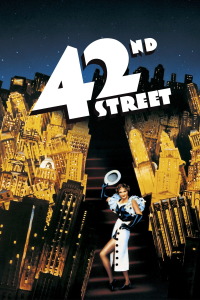
Shot in black and white, this is one of the early Hollywood musicals. It employs a simple plot - an unknown gets cast in the leading role when the star is incapacitated. It's a plot which will emerge again and again in Hollywood movies and musicals, but it won for "42nd Street" the Oscar for best film in 1934.
Much of the film purports to portray the exhausting and pain-racked preparation and rehearsals that dancers undergo. It's actually quite cute (watch Naeve Campbell's "Company" to get a better insight into what it means to be a dancer). It does make clear that Broadway shows make considerable demands of the performers and backstage staff, and that tyrannical directors and executives are not averse to availing themselves of a modern day droit de seigneur relationship with naïve young hopefuls.
Surprisingly, there are comparatively few songs and musical breaks in the film, notably "I'm Young and Healthy" and the epic "42nd Street" - this latter follows the Hollywood convention of supposedly being a 'live' stage performance, the reality, of course, being that only a film set would be large enough for the action. Still, it's a classic piece of Hollywood choreography and frivolity, and laid down the yardstick against which future musical extravaganzas would be measured.
Take away the two major musical numbers and you realise that the plot is minimal, characterisation superficial, even the music is relatively sparse. Yet it would be revived onstage in the 1980's and become one of the first Hollywood musicals to successfully translate to the stage. The film features Buzby Berkeley routines, impossible to translate to the stage, but giving anyone who is young and healthy ... or even old and infirm ... plenty of opportunities to admire the female form - legs, legs, and more legs. Did I mention the legs?
I couldn't actually say that the cast deliver anything electrifying. Ginger Rogers is there, but before her partnership with Fred Astaire rocketed her to stardom, so we don't get any sparkling, set-piece dances. And there's Bebe Daniels, who endeared herself to British audiences by remaining in London throughout the Blitz, making radio comedies and keeping people laughing - but she gets precious few gags in this show. Given the lack of characterisation, there's very little for the cast to get their teeth into - they are, in fact, just figures on a musical landscape, almost as anonymous as Buzby Berkeley's dancers.
Nevertheless, the film does appear something of a museum piece - it certainly hasn't aged as well as some of its contemporaries. It lacks sophistication - even the set-piece finale seems a touch coy and self-conscious. But, worth watching, particularly if you're interested in the development of the musical.
Film and sound quality were adequate, the extras provided with the DVD something of a mixed bag. You get songwriter Harry Warren dueting with Olive Oil and others, an amusing 1934 look at the behind-the-scenes life of a Hollywood studio, and a decidedly missable 1934 Newsreel about Hollywood. There's precious little about this film, apart from nostalgia, to drag it beyond an average marking. It has aged, and, while the minimalist plot and characterisation might have passed in the 1930's, it can appear bland to today's tastes.
This review of 42nd Street (1933) was written by Elisabeth C on 26 Mar 2009.
42nd Street has generally received positive reviews.
Was this review helpful?