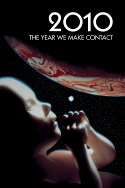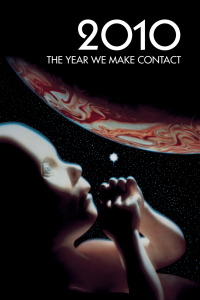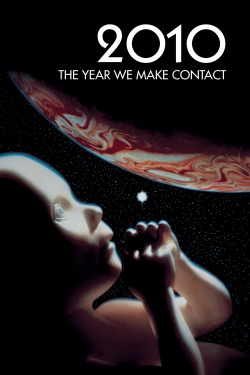
Review of 2010 (1984) by Brandon E — 26 Jan 2009
Considering all the talk, argument and praise associated with Stanley Kubrick's iconic film, 2001, it seems odd that the sequel has gone relatively unnoticed by pop culture. Critics - that is, the few critics who have bothered talking about it - tend to pick on its supposed "overexplicitness". Well, when compared to 2001, which is probably the most mystifying film of all time, pretty much anything else is going to seem overexplicit. All it has to do is feature things happening, and maybe explain a few of them.
At the risk of being burned for heresy, I didn't admire the way Kubrick left everything unexplained. Okay, don't explain the monoliths. But some things, like the madness of HAL, are part of the plot, and are explained in Arthur C. Clarke's (excellent) novel. To leave them completely open for interpretation on screen, by simply not saying things or showing things, isn't creating a great mystery. It's just fudging bits of the story for obscurity's sake. Anyone can delete the scene where Character A explains Plot Development B, and instantly create a mystery of 2001 proportions. In fact, lots of films have characters doing things for no reason. They're called bad films.
In bothering to explain why HAL went on his little killing spree, 2010 isn't going to damage anyone's lofty interpretations of the first film. It leaves the mystery of the monolith largely untouched, even though it provides a lot more information for you to make up your own mind about it. Overexplicit? What, because this time the characters actually discuss what they're doing?
(And on the subject of 2010 being an "unnecessary" sequel, which is also a criticism bandied about by its detractors, surely the explanation of things that went critically unsaid in 2001 is a great basis for a film? The race to find out just what happened out there is, for me, more exciting than the original slow journey to find out nothing. It's a great opening premise.).
Speaking of which, 2010 is a lot more interested in its characters than 2001. Heywood Floyd - here recast as Roy Scheider - is a more rounded main character than Dave Bowman. The situation on the spaceship Leonov, which contains Americans and Russians at a time when the two countries are on the brink of war (which harks neatly back to the ape-men killing each other with sticks at the start of 2001), is tense and interesting. The friendships and relationships formed between them are odd and intriguing, particularly in a scene where a terrified Russian crewman hugs a frightened Floyd for comfort during a dangerous manoeuvre. She kisses him afterwards, and that's that. It's the sort of human touch that the almighty, all-popular first film didn't have time for.
Another interesting dynamic is that between Dr Chandra (Bob Balaban), the man who created HAL, and the re-awakened computer itself on board the Discovery. Will HAL flip out again? Can he be trusted? Or can Dr Chandra, for that matter, since we know he empathises more with computers than people? All very interesting questions, that make for a tense and exciting watch with some unexpected emotional results at the end. What's that? You'd rather just sit here in silence wondering what's going on? Well, have fun with that. To repeat the 2001 experience, in fact, simply mute 2010 and put on some classical music.
2010 has some sharp dialogue, some scary moments, some absolutely spooky moments (as Dave Bowman returns, and visits his loved ones) and at the end, something amazing happens. I still don't fully understand it all, and I wish that Floyd's messages home, particularly at the end, were cut; they're the only real examples, I think, of overexplicitness. But there are mysteries here, just like there were in the first film. The same sense of wonder can be found in the ending, as opposed to the first film, where it was a sense of wondering what the hell was going on. It may be a simpler film than its predecessor, moving its plot at a fair speed and reaching a more definitive conclusion. But some of us like that feeling of completeness. It's not selling out for a film to make sense.
So, burn me if you must, but I'm still going to say it: with its characters, its emotions and its plot, I'd rather watch 2010. Maybe it's less grand, a heck of a lot less mysterious and, you may argue, less meaningful. But it's a boatload more watchable, and in the long run, that swings my vote. A tightly-made space thriller, rarely caught wading through rivers of self-indulgence like the first one, this is snobbishly underrated.
This review of 2010 (1984) was written by Brandon E on 26 Jan 2009.
2010 has generally received positive reviews.
Was this review helpful?