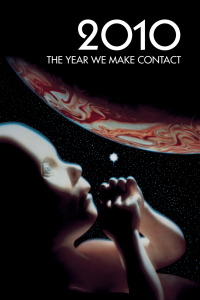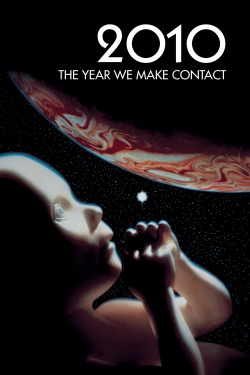
Review of 2010 (1984) by Brandon S — 12 Jun 2011
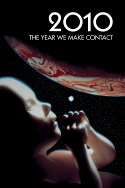
Stanley Kubrick's landmark film, 2001: A Space Odyssey, remains one of the most heralded films of all time. Its groundbreaking special effects, abstract storytelling, lush score and vivid 70mm photography set new standards in filmmaking upon its release in 1968. Kubrick's collaborator on the film, legendary science fiction author Arthur C. Clarke, went on to write a number of sequels to the film and his accompanying novel. 2010, the story's first sequel, found its way into theaters in 1984, as the creative brainchild of multi-talented filmmaker Peter Hyams. Hyams served as the film's editor, director, cinematographer and screenwriter, working with a creative autonomy reminiscent of Kubrick's. While the film has a very different tone from 2001, 2010 is a fitting and worthwhile sequel that manages to answer some of the perplexing questions proposed in Kubrick's masterpiece.
Taking place nine years after the events of 2001: A Space Odyssey, 2010: The Year We Make Contact finds the first film's Dr. Heywood Floyd (Roy Scheider) living in a state of regret over the fate of the USS Discovery, its crew and the ship's doomed mission to Jupiter. The world has since become entangled in political tensions as the United States and Soviet Union teeter on the edge of nuclear conflict. The mysterious black monolith seen in 2001 remains a mystery to scientists on Earth, as does the nature of the Discovery's HAL 9000 supercomputer malfunctions; a malfunction with murderous consequences. Dr. Floyd is given the opportunity to participate in a joint US/Soviet mission to investigate the mystery, but political tensions threaten its success. When all hope of success seems lost, a spectral Dave Bowman (Keir Dullea) beings to appear to members of the crew. Bowman carries a message for humanity, but will humanity destroy itself before it's received?
2010 is nothing like 2001, so it's almost unfair to make comparisons between the two films. 2010 is a much more straightforward movie, as it answers questions, tells a liner story and utilizes a traditional narrative structure. Those seeking the poetic filmmaking of 2001 will be disappointed. That's a shame, though, as 2010 is a fantastic piece of science fiction that is unafraid to present big ideas and answer important questions.
One of the finest aspects of 2010 lies in its realism and attention to detail. Space travel is depicted as being relatively routine, though still not without risks. My favorite scene in the film revolves around the Soviet vessel that carries Dr. Floyd and the multi-national crew to Jupiter, as they work to complete a complex sling-shot maneuver required gain for required gain acceleration for their trip. The film pauses for this sequence, highlighting the terror that each character experiences, before focusing on Dr. Floyd's own reaction to the frightening events. It's a surprisingly warm-hearted and thrilling scene, that instills a great amount of humanity into an occasionally cold and scientific film.
2010 will always be compared to its predecessor; that's the unfortunate reality that has kept 2010 from finding a larger audience amongst fans of the science fiction genre. The film is surprisingly revealing, features excellent performances and relatively solid special effects. Anyone who has enticed by the mystery and beauty of 2001, will surely find 2010 to be thoroughly enjoyable. 2010 is highly recommended.
2010: The Year We Make Contact is a thought-provoking and well-made science fiction film. The picture never tries to outclass or outdo its predecessor and creates a subtle and intricate world of its own.
This review of 2010 (1984) was written by Brandon S on 12 Jun 2011.
2010 has generally received positive reviews.
Was this review helpful?