Review of 2001: A Space Odyssey (1968) by Cinefiles — 28 Apr 2015
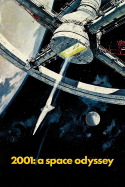
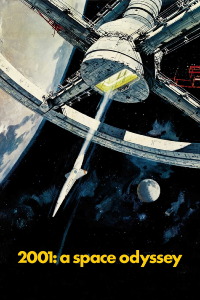
Perhaps it takes the passage of time to gain the perspective to call some films great. Certain movies, despite being ridiculed upon their initial release, have been "re-discovered" years later and labeled as forgotten classics. It's a universal truth that art isn't always immediately recognized as such - this is why so many revered painters, authors, and composers have died in poverty and relative obscurity. Filmmakers face some of the same challenges - in a business climate, courage is the number one characteristic needed by anyone with the goal of fashioning a work that is deliberately thought-provoking but lacking in mass appeal. Such idealistic intentions won't inflate any director's bank account, but they may make an enduring statement. That brings us to the subject of this review: Stanley Kubrick's 2001: A Space Odyssey. Despite gaining additional adherents and growing more respected with each passing day, 2001 would likely be a failure if shown to a typical, MTV-weaned group of multiplex patrons. Watching this film demands two qualities that are sadly lacking in all but the most mature and sophisticated audiences: patience and a willingness to ponder the meaning of what's transpiring on screen. 2001 is awe inspiring, but it is most definitely not a "thrill ride." It is art, it is a statement, and it is indisputably a cinematic classic.
I was around in 1968 when 2001 was first released, but I wasn't old enough to be concerned with anything more substantive than bottles and sleep. However, in the intervening years, I have spoken to several individuals who attended premieres of the film. The level of anticipation surrounding 2001 was as high as that to accompany any cinematic event before or after. Not only had Kubrick developed the project in complete secrecy, but, with the space race in its final laps, the world was ready to inhale any whiff of science fiction. But 2001 did not satisfy everyone. In fact, the initial reaction could charitably be called mixed. While a minority of those in early audiences recognized that they had witnessed the birth of a masterpiece, many movie-goers were nonplused and confused. Several influential mainstream publications panned the film, and, while it was successful at the box office, it was not the blockbuster some had expected it to be. Yet 2001 did not die. Instead, its reputation grew, and, by the mid-'70s, it had become a Goliath.
It's questionable which element of 2001 stands out the most clearly: the pacing, the music, or the visuals. In truth, the three are inseparable. Like a skilled chef, Kubrick blended them together to form a dish of incomparable excellence. They are unique ingredients, yet, once mixed, they can no longer be reconstituted into their original forms. For most movies, this is not the case, but that's one of many areas in which 2001 is an exception. Listening to a soundtrack of this film provokes an avalanche of images in the mind's eye. Can anyone who has seen 2001 listen to the Johann Strauss' "Blue Danube Waltz" and not think of the shuttle docking at the space station? And Richard Strauss' rousing, unforgettable "Also Spoke Zarathustra" has become synonymous with this picture. (In fact, "Zaruathustra" is often referred to as the "Theme from 2001".).
As is true of every Kubrick film, the meticulous attention to detail is evident. Working in close concert with co-screenwriter Arthur C. Clarke and other scientific advisors, Kubrick made sure that every aspect of the film conformed to known scientific fact. His vision is eerily accurate, and, even though we have not attained Clarke's prophesied advancements, we are on the same track. Additionally, there isn't a moment in 2001 that seems dated. The film could just as easily have been made in the '90s as in the '60s.
The Academy Award-winning special effects represent some of the most impressive model work ever committed to screen. They are at least the equal, if not superior to, George Lucas' efforts in Star Wars. Today, visual effects are all about pushing the digital envelope, but there are times when it's worth looking back to how things were done in a simpler era, when technological limitations demanded greater creativity. Douglas Trumbull's accomplishments in 2001 represent an innovative pinnacle.
2001 needs to be experienced to be appreciated. It loses something on a TV screen; even the best home video setup can't replicate what it's like to see the movie in a theater. 2001 does not build bonds between the viewers and the characters or set up a straightforward, linear storyline. Instead, it challenges the audience and inspires wonder. Proponents argue that this is Kubrick's best film; regardless of whether or not that is true, there's no doubting that this movie represents the product of a great director at the height of his powers. 32 years after its release, 2001 has lost none of the qualities that make it an acknowledged masterwork.
This review of 2001: A Space Odyssey (1968) was written by Cinefiles on 28 Apr 2015.
2001: A Space Odyssey has generally received very positive reviews.
Was this review helpful?