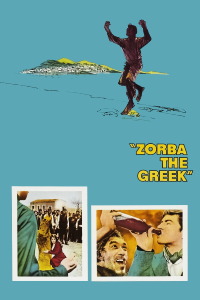
Review of Zorba the Greek (1964) by Antonius B — 09 Jul 2018
Anthony Quinn really makes Nikos Kazantzakis' character of Zorba come to life, turning in a fantastic performance, and conveying Zorba's philosophy of living life to the full, of dancing and laughing in not just moments of joy or success, but also those of tragedy or failure. The book is a masterpiece, and while the movie doesn't (or perhaps can't) get quite as deep, Michael Cacoyannis (producer/director/screenwriter) certainly does it justice, shooting on location in Crete, capturing beautiful images and an authenticity in his film, and letting Quinn shine. We're given a wonderful philosophy in this gruff character who eschews pretense, book learning, rational analysis, religion, and nationalism. He is at once both hedonistic and simple, and also profound and deep, having gone beyond all theories and frameworks while living his life with a kind of purity.
Zorba grabs us from the beginning, asking an Englishman (Alan Bates) "Will no man ever do something without a 'why?' Just like that, for the hell of it?" as they await their ferry, and then quickly sizing him up by saying "You think too much, that is your trouble. Clever people and grocers, they weigh everything." There is a challenge to rationality and convention here, and while the Englishman hires Zorba, it's clear that Zorba will be the one doing the mentoring, on how to live. A part of this is in nudging him into pursuing women, which Zorba does with relish. Aside from his ribald moments, there are others which are pretty risqué, including an old widow (Lila Kedrova) recalling an evening she spent with four admirals, and making it clear they all had sex together after a champagne bath.
There are two very disturbing scenes in the film, one of which is when a young woman (Irene Papas) a man has killed himself over is surrounded by the townsfolk, stoned, and then killed. It's truly horrifying, and even if we can 'accept' it as an honest portrayal of old-world culture (though she's not guilty of anything!), the fact that her death means nothing to the two principal characters, the Englishman especially, doesn't seem genuine. Regardless, it's very difficult to watch. Later, the instant an old woman dies, her home is ransacked and looted, in another ugly mob scene. It's as if Cacoyannis is emphasizing how primitive Crete is, and juxtaposing this with Zorba's primitive (though enlightened) philosophy. This is consistent with Kazantzakis' writing in the novel, as well as in 'Freedom or Death'. There is a ruggedness in the people, as rugged as Crete itself, and if you're sensitive to that or behavior which is far from politically correct, you may not like the film as much.
A couple more quotes:
On aging:
"They say that age kills the fire inside of a man, that he hears death coming. He opens the door and says, 'Come in. Give me rest.' That is a pack of old damn lies! I've got enough fight in me to devour the world. So I fight.".
On being irrational:
"A man needs a little madness, or else he never dares cut the rope and be free.".
On war:
I have done things for my country that would make your hair stand. I have killed, burned villages, raped women. And why? Because they were Turks or Bulgarians. That's the rotten damn fool I was. Now I look at a man, any man, and I say, 'He is good. He is bad.' What do I care if he's Greek or Turk? As I get older, I swear by the bread I eat. I even stop asking that. Good or bad, what is the difference? They all end up the same way...food for worms.".
This review of Zorba the Greek (1964) was written by Antonius B on 09 Jul 2018.
Zorba the Greek has generally received very positive reviews.
Was this review helpful?