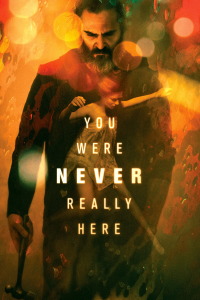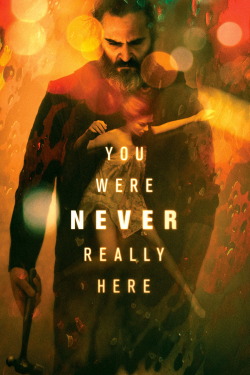
Review of You Were Never Really Here (2017) by K Nife C — 11 Apr 2018
In an age where the highest grossing movies center on costumed vigilantes committing acts of violence and destruction outside and above the law for the sake of some utilitarian homeostasis (that, ironically, becomes more cosmically unstable each episode), it's about time a filmmaker put the vigilante under the gun to reckon with the karma they've accrued. I know, I know, we've had some deconstructionist superhero movies in the last decade, but they've always maintained the premise that despite all of the chaos and death the hero leaves in his wake, good guys are good, and bad guys are misguided if not wholly evil. Lynne Ramsay's You Were Never Really Here doesn't deconstruct this vigilantism as much as completely decimate any romantic preconceptions of it with a ball-pein hammer. Everything about Joachin Phoenix' tortured torturer "Joe" is cranked up to eleven as he wanders through a surreal nightmare, followed by his trauma, in search of retribution.
There are a few very obvious cinematic influences and references that should be made clear from the trailer, the most blatantly obvious one being Scorsese's Taxi Driver. That and Refn's Only God Forgives all share with it the neon-noir aesthetic, the violent protagonist, and the moral/emotional catalyst of underage prostitutes. How Joe sets himself apart from Travis Bickle or Julian is with a psychosis wrought from witnessing the horrors of this world in the line of duty while trying to do the right thing. His PTSD from the Middle East and his time in the FBI have formed him into a person with a clear sense of right and wrong, but those experiences have perverted his sense of balance and retribution. He has to hyperventilate to stay calm, and he has to beat, maim, and kill to bring about "justice". Sure he's saving young girls from sex-traffickers, but he's getting paid to do it. Then there's that crazy little glimmer in his eye when he buys a hammer.
With that sort of setup you would assume there would be lots of scenes of vindictive blood and guts. I won't say there aren't any, but this certainly isn't a film like Death Wish where one is expected to gleefully cheer on violent murder. Much like a Michael Haneke film, the violent acts are rarely presented on screen, and if they are it isn't the purpose of the film to glorify them. The dead and dying, the oppressive din of suffering voices are all more important focal points of the camera. These are the images that torment Joe, and we can more faithfully enter into his trauma via this stylistic choice. Johnny Greenwood's frenetically danceable and cacophonously eerie score solidly intensifies Joe's tenuous grasp on reality while he is lost between moments of clarity and visions of senseless death.
What I think elevates the film past the best of psychological thrillers or action flicks is that You Were Never Really Here is a film that points to the best of cinema in the last few years and the world surrounding film today. There are visual echoes of Good Time, Get Out, maybe surprisingly A Ghost Story, and unsurprisingly Inherent Vice. On the other hand it is difficult to go much further into this without getting into spoilers, but you would be hard up to find a more fitting distillation of the #MeToo movement than Ekaterina Samsonov's character, a PTSD-riddled girl with an extensive history of being systemically abused by the power structures in her life. The first half of the film is "What?" The second half is "WTF?". All of it leads to the conclusion, like I'm sure many are asking in Hollywood and abroad, "Where do we go from here?" Perhaps we've all been ghosts in a mansion of horrible deeds, only now emerging from the delusion that we weren't complicit in the hatred and pain that plagued our society.
The plot synopsis on Wikipedia makes it seem as though what we are watching is certain and factual. To assume that these events and connections have all occurred without question undermines the feverish thought process and perspective of Joe, and it also assumes he is a reliable narrator. I don't believe that he is. In fact, I'm not even sure he's really there (damn, I would have nailed that titular reference if not for tense and second vs. third person pronouns). Some of the more surrealistic sequences give me the impression that he is a ghost or dreaming. I don't know, and I don't want to, and it is exactly this ambiguity that makes what could be a miserable or fruitless revenge story into a riveting and thought-provoking work of art.
This review of You Were Never Really Here (2017) was written by K Nife C on 11 Apr 2018.
You Were Never Really Here has generally received positive reviews.
Was this review helpful?