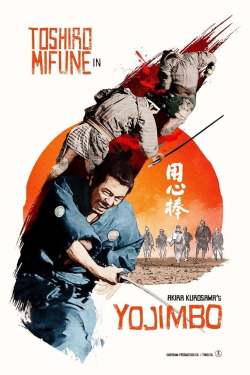
Review of Yojimbo (1961) by Harpreet S — 16 Jun 2013
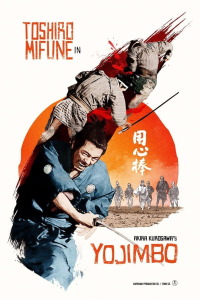
There aren't many films I love more than Akira Kurosawa's "Yojimbo." Sure, I could name several films that may be more empowering, more important in my view, films with more depth; but if I were to make a short list of just my favorites, ones I wholeheartedly enjoy, this Kurosawa masterpiece would easily be there. It has one of the greatest opening credits sequences, one of the most awe-inspiring musical scores, and one of the most unique location sets for a story. Majority of the events that take place are in the open, it's somewhat strange but at the same time fascinating how so much action is happening in front of everyone's eyes but not many are able to take advantage except for Sanjuro (Toshiro Mifune). Kurosawa was a genius; he was able to create masterpieces out of very simple stories, whether it's seven men obliging to help out the farmers in "Seven Samurai," a young doctor learning what life should be from an older one in "Red Beard," or a ronin trying to destroy two gangs in a small village in "Yojimbo.".
While revisiting it, some of the shots I found really compelling were when character action is taking place both in the foreground and background; those specific shots especially forced me to believe what I was watching is more than just a movie; it just felt so real to me. Every actor gives brilliant performances, this might be Mifune's most restrained with very short bursts of fury; he is always observing, reminiscent of James Stewart in Alfred Hitchcock's "Rear Window." After Mifune's Sanjuro, my favorite character was Inokichi (Daisku Kato); the dim-witted, chubby brother of one of the two crime lords; I can't explain how adorable I found him to be especially when he is mad with his bottom lip under his teeth; in one sequence involving a cemetery he exclaims: "Hell, I see ghosts and I feel relieved," while in reality he is terrified. The film also has Takashi Shimura and Tatsuya Nakadai, the two best Kurosawa actors after Toshiro Mifune; Nakadai's introduction is only seen to be believed! Watching "Yojimbo" again made me realize it's a lot funnier than given credit for, it also cannot be categorized with narrow labels; as profound of an artist Kurosawa was he was still able to make maybe the coolest film ever which still provides an underlining of his trademark moralistic views.
This review of Yojimbo (1961) was written by Harpreet S on 16 Jun 2013.
Yojimbo has generally received very positive reviews.
Was this review helpful?