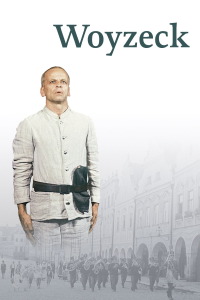
Review of Woyzeck (1979) by Matthew A — 27 Aug 2010
Werner Herzog stripped bare the theme of "innocence" in his two films with Bruno S.("Stroszek" and "The Enigma of Kaspar Hauser"). In this film, based on a stage play of the same name, then furthered his exploration of the other theme that he is very inclined to vividly show into the silver screens: madness.
Of course, this would not work out or even materialize without Klaus Kinski, the only perfect man and actor built on such roles that defy sanity. In "Aguirre", Kinski and Herzog collaborated to show madness at the peak of its powers.
While in "Fitzcarraldo", they then depicted it with such humanistic touch and strands of optimism that derives from music and opera. Then at last, the film sandwiched between the first two, "Woyzeck" is the presentation of madness at its most hopeless, helpless, and pitiful, with a very much vulnerable Kinski in the lead.
He acted out the role with a certain lack of personality and authority, two traits commonly attributed to the ever eccentric actor, while showing through his eyes how distant Franz Woyzeck was from the rest of society, and having imaginary, tormenting voices as his only chance to have an intimate talk.
Although "Woyzeck" is as psychological as any movie can be, it's also an ever-questioning film about how society views singular murders as nothing more than a grisly crime, while exterminations on the battlefield was a thing of heroism.
It's a rather old sentiment by the Chaplin classic "Monsieur Verdoux", but how Herzog delivered its message was very brilliant in its simplicity; a quote in the end of the film, displayed on the serene backdrop of the murder scene.
It's a line very much assured of its stance, but deep within the words, was a subliminal thought that questions humanity, just as how the tormenting voices continually echoes into Woyzeck's fractured psyche.
This review of Woyzeck (1979) was written by Matthew A on 27 Aug 2010.
Woyzeck has generally received positive reviews.
Was this review helpful?