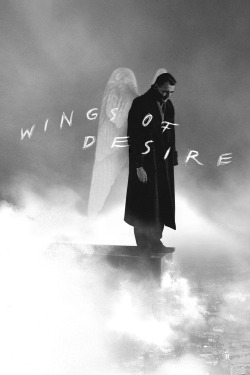
Review of Wings of Desire (1987) by Bradley T — 04 Mar 2010
Wim Wenders: Wings of Desire the tale of the re-born angel.
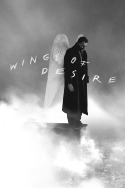
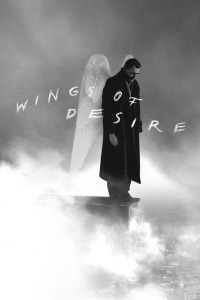
In Wim Wenders' Wings of Desire the angels find themselves towering over the streets of Berlin, serving as day time watchmen. When the angels aren't at top a high perch they spread themselves amongst the city, to observe the people. The movie curiously follows two angels, Cassiel (Otto Sander) and Damiel (Bruno Gantz), who have been in existence since the beginning of time. The two have watched the city grow from nothing, only to crumble and decay before their very own eyes. Unlike the Angels in the Outfield the 1994 William Dear movie, these angels cannot hit home runs or physically interact with humans. In fact, the angels have no senses of any kind, which is necessary to create this desire among the angels. The director builds upon this idea by shooting the film in black and white to portray how melancholy their lives truly are.
Since the angels have been around for such a long time, they have developed trends to make daily life more interesting. The angels have a natural tendency to lurk around public places to listen to the thoughts of the unknowing people. Traveling to the subway, library, or industrial parks, the angels take notes on the human interactions they witness. Similar to ghosts, the angels are invisible to most adults but can be seen by children. They move through each scene with tranquil and calm movements, as if they were floating. Placing a hand on the shoulder of a man reading or woman sitting on the subway the angels can however provide a calming presence.
To provide some type of relief from the serious plot, the director stops to provide some entertainment with the Alekan circus. The circus scenes are not just pointless fillers, but in a sense set up the plot of the movie. Damiel and Cassiel attend an early circus that is filled with young children, who laugh and interact with the angels as if they where human. I think it is appropriate that the children, who are assumed to be very innocent, have the ability to not only, see the angels, but can talk to them. The children and the angels can be closely linked because they both have this need to learn, but are unsure of their true calling.
Damiel becomes the focus of the movie about half way through the film after he attends a night time circus act. The trapeze artist (Solveig Dommartin) that has a vibrant and standoffish performance catches the eye of Damiel. He follows the woman for sometime before realizing that he has longed for her his entire life. After speaking with his long time friend Cassiel he decides to become a human. Dropping into the world the angel is awoken by bronze armor smashing his head. Damiel's cliché entrance provides some comedy and introduces the character to his new found senses, like being able to experience pain, the cold, and interaction with people. As he starts his quest to find the trapeze artist he meets a man similar to him. Peter Falk (playing himself) is an American actor who is a very curious individual. His role in the movie allows him to interact with the people of Berlin, as he finds much pride in acting and drawing. But his main purpose in the film is to determine why he senses a spiritual type feeling from an unknown source. This feeling is later explained when Falk has a conversation with Damiel but can't see him. Later you learn that Falk was at one time an angel which provides evidence to why he could communicate with the angels.
The movie jumps randomly from scene to scene which can be confusing at times. Along with the variety of languages that cluster the audio, it creates a problem focusing. I think that the excessive reading of subtitles pulls your mind away from the theme of the movie. Berlin has fallen into a state of being that is dreadful and dark where the day is cloudy with gloom and the people are too. The pop culture that is portrayed in the certain portions of the movie is moody and dreadful and flows like something out of a horror movie. It is flashy and upbeat at times and slows down to an almost blues type melody that contradicts the entire piece. The trapeze artist and Damiel are drawn close together in a concert setting that depicts this culture.
I find the final outcome and ending to the movie to be cut short, if you take into account the entire idea of the movie. The angels can recall more than any being that lives on earth because they have been in existence for such a great time. But Damiel truly experiences life, or what Peter Falk describes as being alive, when he has his first coffee. The movie may be confusing at first but after you understand the angels purpose, the film is very interesting. Wings of Desire broadens the spectrum of real life and asks the question, what is life? The movie is a true representation of the importance of life and how every little detail should be considered. Overall I would give the movie two sideways thumbs but it is worth watching once.
This review of Wings of Desire (1987) was written by Bradley T on 04 Mar 2010.
Wings of Desire has generally received very positive reviews.
Was this review helpful?