Review of Wild Strawberries (2012) by Tans D — 14 Mar 2009
"Wild Strawberries" is one of Bergman's least esoteric and most focused works. Every one of its 90 minutes is dense with theological and existential content, yet it is also a lilting, leisurely and romantic meditation on the quandaries of life and its myriad disappointments. While Bergman tended to make super serious and ponderous "artsy" product as he advanced in his career, "Strawberries" is perhaps his most accessible and least despairing work, in stark contrast to its heavy themes.
Only the first three minutes, concerning Professor Isak Borg's misanthropy and self-imposed exile in his study, hint at the dark, dark material in the "Silence of God Trilogy". With the impression that life is intrinsically bleak, and humans can only relate to each other through criticism, Borg has cut himself off from all but the most basic human interaction (his deepest relationship is with his elderly housekeeper). Yet on this day, he must travel across Sweden to accept an award at his alma mater for a lifetime of esteemed service. As a doctor, he understands all the ins and outs of humanity in biological terms, yet he's a dunce when trying to decipher their emotions. Mysteriously shirking a quick plane ride for a spiritual road trip, his plans for an isolated trek fall apart when his daughter-in-law, separated from his bitter son, decides to travel with him in the hopes of reconnecting with her husband.
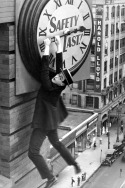
The stage may be set for a conventional "getting to know my wacky relatives" sort of tale; Bergman is beyond that, using his original talent as a stage director to film two surrealistic and unsettling dream sequences. The first involves a window that sees into Borg's (brief) future, a clock without hands, a three-wheeled horse cart carrying a coffin that falls out and contains a still-living body. The horrible final revelation, explicitly implying his fear of mortality, recurs throughout as an ominous timpani playing a single low note in a rhythm suggesting a heartbeat.
As we journey through the picturesque Swedish countryside, Borg stops at his childhood home and recalls his upbringing, in a house with ten children, a domineering mother and a halfway absent father, with Proustian clarity. Torn by feelings over a relationship with his cousin, and subsequent unreciprocated affection, makes him wary of romance. Three young hitchhikers join the two travelers, and "Strawberries" smoothly shifts into a study of generational viewpoints. The kids passionately argue about God and other semantics, while failing to understand the nuances granted to individual viewpoints by life's experiences. Borg's erstwhile cousin, seemingly reincarnated in the form of the female hitchhiker, has an unexplained attachment to the old man. Perhaps she's wise enough to understand the richness that age gives to our worldviews. As her two male counterparts engage in a fistfight over the viability of a God that actively watches Mankind, she shares the derisive laughter of the older folks. When the two bitter chums reenter the car, she mirthfully chortles, "Well? Does God exist?" Nothing has been solved, nothing gained save further separation between two extreme ideals.
Even as Fate engineers a car accident that puts two more transients in Borg's antique automobile, and the couple turns out to be hopelessly meanspirited to one another and constantly bickering, the tone of "Strawberries" never veers toward the melodramatic. There's a profound depth to the composition as three generations occupy different rows of bench seats; the young and old separated by the verbally sparring middle-aged husband and wife, who know each other so well that every insult, no matter how innocuous, wounds like a knife. Of course they're tossed out to the roadside rather quickly, better for them to walk and bicker in solitude.
Visiting Borg's 95 year old mother proves a rather morbid detour, but immediately afterward, he is rewarded for past good deeds by the return of another good deed. Soon, any misanthropy has evaporated and he's sharing in the jollity of the youths. In a vivid juxtaposition, this leads into the second dream sequence that blends flashback, paranoid fantasy and, once again, the fear of mortality as viewed through clouded windows. Bergman's use of overcast skies and expressionistic lighting recall the visuals of "The Seventh Seal" and serve to isolate our protagonist from those around him. At journey's end, with the strange ceremony in unsubtitled Latin, the payoff feels almost perfunctory and the real, concrete character development shows in the single scene with his son going off to a dance while Borg lays in bed, exhausted. A simple exchange with the son and his wife is all we need; no tearful confessions, hugs or speeches delivered during rainstorms. A final flashback is vague yet it achieves a rare perfection in its simplicity. Sure, nostalgia for one's youth is hardly a groundbreaking topic, but the scope achieved through the cumulation of images encompasses most every facet of this old dude. A final, heartrending harp solo sends us (and him) on our merry way.
This review of Wild Strawberries (2012) was written by Tans D on 14 Mar 2009.
Wild Strawberries has generally received positive reviews.
Was this review helpful?