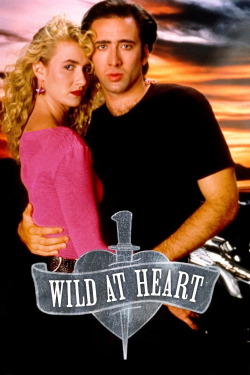
Review of Wild at Heart (1990) by Blind P — 06 Dec 2009
This goes without saying if you are familiar with his work, but each and every movie David Lynch has ever directed is the type of movie that requires multiple viewings, if not only to try to understand exactly what the hell is going on in the story, but to re-soak one's self in the detailed, calculated, overwhelmingly cinematic mood and style he layers on top of each and every scene. Lynch is the type of director who can simply take a quiet scene where a woman walks into a room and turns to look at a man standing there, and somehow make it seem like it's the most terrifying thing you've ever watched. His famous use of shadows and deep, unignorable sound design (which usually constantly hums in the background throughout all of his work), added to his love of twisty, not entirely coherent subject matter, which usually consists of weirdoes and degenerates, has made him a hero to the indie crowd. He's pretty much become a modern day, strangely more intimate version of Stanley Kubrick, in that every movie he takes on becomes automatically important to cinema history, seemingly just because it was directed by David Lynch. Like Kubrick, Lynch never lets up on his own style and ideas, injecting them deeply into every project, and never exactly makes them entirely clear to the audience, which is part of the appeal, and yes, the fun, of David Lynch.
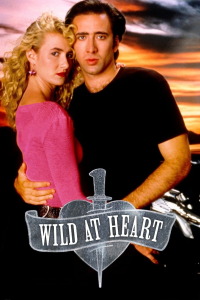
"Wild at Heart," his much debated 1990 follow up to his 80s-era masterpiece "Blue Velvet" and his then ongoing TV-hit "Twin Peaks," is a much more straightforward piece of work than most of his other movies, but that doesn't mean it's any less weird or complex than his stranger labyrinths (such as "Eraserhead," "Lost Highway," "Mulholland Drive," and "Inland Empire.") He takes a relatively straightfoward story, stabbing at the typical "young lovers on the run" genre, and layers it with so many Lynchian trademarks and sequences the viewer realizes it's not what is going on in the story, but HOW it is going on. Lynch is never 100% interested in the plot, but more the feeling and mood of the movie. The result is a frustrating cinematic experience for some, because it feels like there is a "regular" movie in there somewhere that has gotten lost in Lynch's craziness. But more open-minded viewers will see that Lynch's trademark madness really enhances this tale. He is still an underrated genius when it comes to character detail and actors. "Wild at Heart" is proof than in the middle of chaos, Lynch finds the right way to make his characters not only feel real, but makes their hopes and desires feel real as well, as if all of this could in fact be really happening. He can put an actor in a role, and linger on them so long in character that no matter how recognizable the actor is, they register while watching the film as the character they are playing and nothing else on a distracting level.
Nicolas Cage gives one of his best performances in the lead role of Sailor Ripley, doing a non-stop Elvis impersonation through the film (even bursting into crooning songs here and there) and brimming with the actor's famous intensity that has, in recent years, dissolved into self-parody. Watching Cage in this movie reminds one that this short-fused actor was once perfectly matched with wild material he could still resonate with. Perhaps it was his youth and pre-stardom that led to this type of overbearing, yet highly controlled type of performance, but it's hard for me to find a better Nicolas Cage role in which all of the actor's trademark quirks aligned to make something special. Laura Dern has always found her home as a great actress in Lynch's work (watch "Inland Empire" for further proof), and once again, her work here is outstanding. As Lula, she is sexy, highly Southern, two steps away from white trash, and still quite intelligent, philosophical, and wise. She is the heart of the movie, and quite a creature to look at. Lynch gives the heart of the movie to their love story, and it's probably the one thing that works consistently well through the whole movie, on both a mainstream viewing level and a Lynchian level. They feel like living, breathing people, and it's rare to find that in any movie, particularly one this bizarre.
Willem Dafoe is probably the most memorable of the supporting cast, sporting nasty gums as Bobby Peru, the most famously discussed and idolized character in the movie (similar to Frank Booth in "Blue Velvet"), probably so for his late-in-the-game appearance and the general distaste that circles his character. Dafoe's snake-like creepiness and charm has never been put to better use than it has here. A pivotal scene between Dern and Dafoe recalls the more uncomfortable moments of "Blue Velvet," and quietly parodies it for a second, before pulling back and letting the viewer breath as Dern does. Diane Ladd somehow got an Oscar nomination for her over-the-top turn, but in the middle of all this craziness, it doesn't really seem like anything that special or noteworthy. J.E. Freeman and Harry Dean Stanton get to do their weird character actor thing and end up being some of the most normal and logical people in the movie (a rare feat for these actors, indeed). Crispin Glover's cameo is so out-there it serves only really as a reminder that David Lynch is insane for filming this kind of stuff, and Glover is insane for acting it out. It's a scene that comes out of nowhere in "Wild at Heart," has absolutely no impact on the storyline, but is still one of most effective and memorable in the film.
"Wild at Heart" is not one of David Lynch's masterpieces in the "Blue Velvet" vein, but it's not of his complete duds (in the "Dune" vein) as many have suggested upon a first viewing. It falls rather happily and comfortably in the middle. It lacks much of the ambiguity and mystery of a lot of Lynch's films, while still retaining his surrealism and insanity, and sometimes it's a tough rope for him to walk. At best, he seems to be doing Quentin Tarintino material better than Tarantino (and it is odd to know that this came out before the HIGHLY similar scripts for "True Romance" and "Natural Born Killers," which Tarantino both scripted). At worst, his film can seem meandering and over-the-top, but once again, repeated viewings may distill that notion. If you're a David Lynch fan, prepare yourself for something different but still highly familiar. If you're not, watch "Blue Velvet" and "Twin Peaks" first, then get back to me.
This review of Wild at Heart (1990) was written by Blind P on 06 Dec 2009.
Wild at Heart has generally received positive reviews.
Was this review helpful?