Review of Werckmeister Harmonies (2001) by Andrewburge — 01 Sep 2018
"All I ask is that you step with me into the boundlessness where constancy, quietude and peace, infinite emptiness reign." And yes, I ask you to do just that. This is a film which mesmerizes you if you allow it. I say that because in the nameless isolated village in Communist times there is a sensation of abnormality, almost like a twilight zone if you will.
Throughout the entire picture there is a sustained level of surrealism. The film itself only has 39 shots; yet co-directors Béla Tarr and Ágnes Hranitzky masterfully use camera movements to absolute precision. Tarr is an observer. He is respectful and patient with his characters. He is personal, human, capturing their expressions, often lost in thought. The very first scene takes place in a bar at closing hour, where the drunk patrons are sent home, but one insists that János (Lars Rudolph), the local newspaperman, should show them his act. What is his act? He starts a theatrical, Shakespearean sketch about the birth and nature of the Universe, where one drunk patron is put in the middle of the room to be the Sun, another is the Earth and another is the Moon rotating around the Earth, which rotates around the Sun. It is funny, ambiguous, bizarre, surreal, beautiful, sad, all at the same time. It evokes so many emotions, so many thoughts. In the end, the shot pans away as the men stand in place. On their faces, you can see their emptiness, their minds sucked out by the political condition they are in.
This is what, I believe, Tarr wishes to express the most through this film. The communist regime that plagued Eastern Europe was not about damaging economy or social stability, it was not even about the lack of freedom, but the lack of culture and art. It is humanity's most uplifting characteristic, it is what connects us to the divine. Which brings us to György Eszter (Peter Fitz). A man so hungry for artistic embrace that he left his wife and resorted to the very fundamentals of music which praised the gods, believing that everything after the works of musical theorist Andreas Werckmeister is not worthy of being artistic.
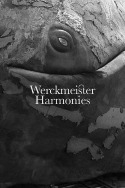
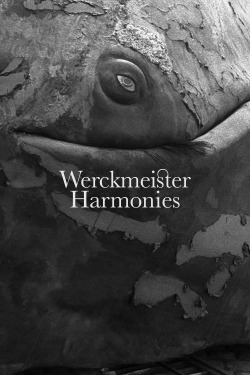
More so, there is a circus coming to town. It involves a giant dead whale as its primary attraction. János if the first one to see it. He is lost in silence, and I was too. So interesting, a dead whale, tons of rotting flesh just put on display, its lifeless eye looking back at him. He remains in awe of what he saw, expressing "how mysterious is the Lord that he amuses Himself with such strange creatures". The circus also brings one named The Prince, yet he is never shown. He is a deformed man, who brings a revolutionary tone and incites at revolt.
Not soon, the people revolt. But this was not surprising. Tarr embraced this mental void and darkness from the start. There was a constant sounding hum in nearly every scene, there was barely and dialogue except village gossip about the horrors of the Prince. These are all delivered with a theater panache, one of the best examples being the hospital scene. There is a crowd moving towards it and for a good 4 minutes they are filmed walking, but not from afar. You are put right in the middle of them, the camera panning through their faces. Afterwards, they beat the patients, and when they leave, yet again, they do it in a Shakespearean organized manner.
'Werckmeister Harmonies' is, undoubtedly, a masterpiece. Whether the dead whale is an allegory for the lifeless Communist society, or just put for artistic merit, I do not know. Whether the film is about the close-minded apocalyptic visions of Communist villagers or Tarr's own fears and experiences of the end of the world in the year 2000, I, again, do not know. But that's why I like it and that's why this is one of the greatest films ever made.
This review of Werckmeister Harmonies (2001) was written by Andrewburge on 01 Sep 2018.
Werckmeister Harmonies has generally received very positive reviews.
Was this review helpful?