Review of Werckmeister Harmonies (2001) by Eric B — 28 May 2012
Approaching my first Bela Tarr film was an intimidating task. So much mystique and highbrow acclaim is attached to his work, and he's one of those directors whose name is habitually dropped by pretentious cineastes straining to impress. "Werckmeister Harmonies" is doubly daunting, due to its heady title and all the belabored dissection of its long takes (just 39 shots in 225 minutes, or so the legend goes). But fear not -- the film isn't quite the agonizing epic one expects. It's slow, sure, but let's call it Wim Wenders-slow, not Andrei Tarkovsky-slow. The script is light on dialogue, so much of the labor involves just following character movement. No problem, especially if you're comfortable watching the silent classics.
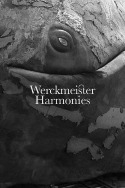
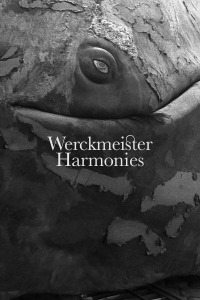
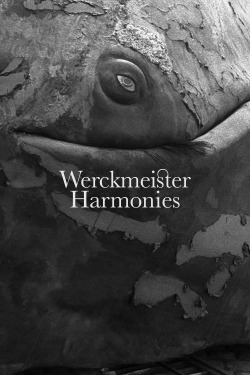
"Werckmeister" is as much about mood and cinematography as its story, and the scenario isn't particularly elaborate. Janos (Lars Rudolph) lives in a small, poor Hungarian town. He apparently is viewed as some sort of eccentric philosopher, given his opening barroom demonstration of planetary movement (at 10 minutes, it's perhaps the single longest shot). His peers have been locked into resigned misery but become freshly agitated with the arrival of a traveling sideshow. A road-worn trailer carries its two main attractions: a rabble-rousing political figure known as "The Prince" and the semi-preserved corpse of a large whale.
Mysteriously, Janos seems to be the only person who buys a ticket to see the whale. The others mull about the trailer but do not approach. This and other variables faintly suggest a rejected Christ figure, but perhaps I'm overanalyzing. In any case, the rhetoric of the unseen "Prince" (devil?) causes an uproar among the people, who turn to Janos's uncle Gyorgy (Peter Fitz) for leadership. Gyorgy's estranged wife Tunde (former Fassbinder icon Hanna Schygulla) spearheads this pressure. But reluctant Gyorgy would rather spend his time gnawing on arcane issues of musical tuning -- hence the film's title. Eventually, in the most memorable sequence, the village's dissension explodes into pointless violence.
Drawing a message from "Werckmeister Harmonies" is risky, particularly if (like me) you don't have much knowledge of Hungarian culture. It may be best to just soak in the rich, black-and-white imagery and shiver at the Kafka-esque atmosphere.
This review of Werckmeister Harmonies (2001) was written by Eric B on 28 May 2012.
Werckmeister Harmonies has generally received very positive reviews.
Was this review helpful?