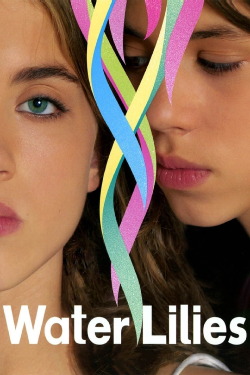
Review of Water Lilies (2007) by Lubaina K — 30 Jan 2009
Naissance des Pieuvres (Water Lilies).
Written and directed by Céline Sciamma.
Starring Pauline Acquart, Louise Blachère, Adele Haenel, Warren Jacquin.
Teen age lust gets a robust, gentle treatment in this French coming of age story by first time director Céline Sciamma.
Marie (Acquart) is a shy, awkward and exceedingly skinny fifteen year old who is ably looking for a sense of adventure. As the film opens she is in the stands watching a synchronized swimming competition featuring Floriane (Haenel), the captain of the local team. It quickly becomes apparent that Marie is obsessed with Floriane. She asks her if she can come along and watch the team practice and in one glorious scene she enters the pool and watches the maneuvers underwater. It?s an achingly beautiful sequence and sets up Marie?s POV quite effectively. She seems to take an erotic charge from the experience and is deeply influenced by it as the film progresses. She and Floriane begin to hang out and in another telling scene Marie steals Floriane?s garbage and quickly races home. She dumps it out, smoothing out a crumpled piece of paper and taking a bite out of a discarded apple. One gets the sense that she wants to be Floriane and the garbage is one way of allowing Floriane to speak through her.
Marie?s best friend is Anne (Blachère) who is more boisterous and chatty. She is obsessed with François (Jacquin) and is devastated when she sees him kissing Floriane. Nevertheless she approaches François on several occasions and is quietly, subtly rebuked although there is clearly something in François?s eyes that is more telling than his immediate demonstrations would otherwise suggest. François is frustrated because he is quickly learning that all the rumors about Floriane being an easy lay are not true. Floriane remains a virgin and seems to take delight in pushing boys and men to the edge of their endurance. She?s flirty to the point of madness and clearly imagines herself completely in charge of whatever situation she finds herself in.
The film is a unabashed celebration of the female form. Extended limbs; arched backs and slow, agonizing pans of gymnastics give this film an eroticism that is matched by the interactions between the three female characters. There are real and lasting discoveries that are expertly rendered in a deliberately paced film that relies on extended takes where often nothing much is said. The raw hunger on the girls?s faces says everything that one needs to know about these characters, their hopes, and fears about acting upon their ambitions.
As Marie watches Floriane it is clear that she is harboring a tremendous longing that must be released in some form or another. She is not thrilled that Floriane is focused on teasing François and seems to wish that she would become the target of Floriane?s affections. Yet when Floriane announces that she wishes Marie to be her first lover Marie rejects the proposition outright only to recant later. The subsequent love scene between these two characters is a bit painful to watch. Indeed, it?s not much of a love scene as nothing is really shown yet it?s clear that something is happening slightly off camera. It?s still a charged, provocative scene that accentuates both character?s innate awkwardness regarding sexual matters. They both don?t quite seem to know what they are doing and this fact adds to the poignancy of the scene.
Marie spends much of the film studying Floriane in the hopes of picking up some clues from her. Floriane is much more developed?closer to a woman?than the rail thin Marie who cannot bring herself to undress in front of the other girls. Marie nevertheless carries herself with purpose and one is left with the impression of a girl who has her sights set on a specific goal which is permanent and lasting to her and fills her up to the point of bursting. She confesses to loving Floriane and it?s clear that this admission is terribly difficult for her to articulate. All she knows is that she wants desperately to be near Floriane at all times and that she cannot bear the thought of being apart from her for any reason whatsoever. This is why François troubles her so much. It?s the possibility that Floriane will sleep with him and be lost to her forever. Marie cannot bear such a potential outcome and it proves to elevate her desire to a place typically reserved for religious conviction.
Anne is an entirely different animal from Marie. She?s far less self-conscious and certainly bolder in how she approaches the measures that matter in her life. She approaches François openly and presents her own hunger to him without provocation. She is willing to be rejected but firmly convinced that she can win him over through a series of strong, deliberate actions. She doesn?t much relate to Floriane as both girls are vying for Marie?s affections and loyalty. In a sense Floriane and Anne are rivals both seeking to assure a firm hold on Marie who nervously attempts to hold her ground and not get swayed in either direction. It?s not quite as if they are both tugging at Marie but they are each attempting to assert their influence over her. It?s not altogether clear but there is a legitimate intimacy between Anne and Marie but it?s not as overt as that which Marie shares with Floriane.
The cinematography by Crystel Fournier is painterly and richly textured. It creates a heightened sense of awareness and captures the tense eroticism at play between each of the characters. This is very much a film about sex as it is played out by adolescents who experience much of life as if it were a life or death struggle. In one late scene Floriane is dancing in slow motion and the camera focuses on her body as an instrument of pure form. It encapsulates the rapturous freedom of movement that the film embodies as a whole. In many ways this film slows down the often frantic expressions that typify most depictions of youth in cinema. These are thoughtful, deeply caring individuals who play out their fantasies while maintaining their core dignity throughout. The film moves along slowly, methodically, searching for delicate methods of conveying strict actualities about carnal truth.
The performances in this film are open and natural. Pauline Acquart reminds me of a young Charlotte Gainsbourg, specifically in the Cement Garden and it goes beyond the physical resemblance the two actresses share. There is a delicacy about each of them, a true sense of wonder that comes through in their eyes, how they look at things. Acquart possesses the rare ability to remain reserved while her character pushes herself forward toward her actual goal. It?s that combination of conservatism and forthrightness that makes Marie so endearing. As Anne Louise Blachère relates an eloquently rendered desire that is bit more scattered than the others. Anne is more fully aware about how she wants to deal with the actual hormonal changes that are taking place inside her. She seems to have a clearer picture of what sex is than the other girls and Blachère captures this effectively. Adele Haenel captures Floriane?s aloofness and her occasional coldness regarding others who want to move in on her. Haenel is radiant and gaspingly beautiful in this role, in a way that will translate to a long, adventurous film career playing a whole host of difficult women who can?t seem to make up their minds. Indeed, all three actresses share the same commonality. They all have bona fide star power and should succeed in creating viable, exceptionally lengthy careers for themselves. Warren Jacquin does the jock thing rather well. His character is something of an external force attempting to persuade Floriane to take him to bed so that all will be well. His anguish is readily apparent on his face as he cannot get the fickle Floriane to acquiesce to his raging desires.
Overall, this film is something of a small masterpiece. It is deeply rooted in the confusing, strange terrain of youthful sexuality. It?s never cloying or obvious and each performance rings solidly of truth. It?s gentle and sweet when it needs to be but also tough and resilient when relating the very difficult machinations of the heart. The film is fiercely intelligent in how it explores an oft ignored aspect of the transformation that all of us must endure as we ripen to maturity. These are fearlessly drawn characters who feel very real emotions and agonies that are universally applied to all human experience. There is a raging necessity to every scene, particularly those that demonstrate the fumbling confusion of first love in silent tableaus that speak with a searing authenticity.
This review of Water Lilies (2007) was written by Lubaina K on 30 Jan 2009.
Water Lilies has generally received positive reviews.
Was this review helpful?