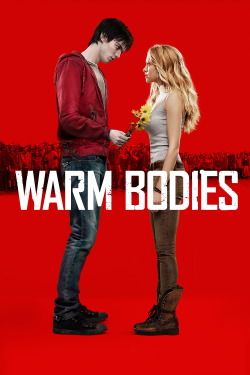
Review of Warm Bodies (2013) by Meg G — 01 Feb 2015
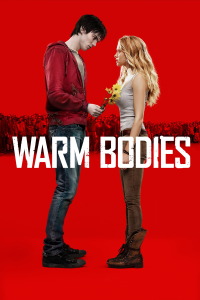
There's little like a Young Adult romance between a young woman and a man-eater. Released in 2013, Jonathan Levine's "Warm Bodies" offers a quite open-to-puns (the taglines for this movie are, quite frankly, murder) premise. Standing by itself, the film and the novel it's adapting (a film adopting a novel adopting a written play adopting a stage performance, as it were) encapsulate an ambitious narrative. The story dissects and alters the standard "lore" on zombies, and the narrator of this future post-apocalyptic setting is not a human survivor, but rather one of the zombies.
The film's story goes past many common themes in zombie movies, all while being a charming romance. Not only that, but the love story between R (Nicholas Hoult) and Julie (Teresa Palmer-strangely enough, I remember her from an odd Australian film on Chiller named "Restraint" where she acted alongside Stephen Moyer from "True Blood") is based on William Shakespeare's tragedy Romeo and Juliet.
Instead of a long feud between families, "Warm Bodies" introduces a battle between the living and undead, where the living have an understandable opposition toward those who ate their loved ones' brains. (For decorum's sake, I'll abstain from any other references to a male protagonist "eating" or "eating out" his lover.) Many of the characters, in their transformations within this narrative. maintain similar names to the Shakespeare protagonists. R, the narrator, isn't quite alone in body; he has his best friend, M (Rob Corddry) who is rather laconic-in contrast to his Elizabethan counterpart. In Shakespeare's tragedy, Paris is Juliet's suitor, while Perry (Dave Franco) is Julie's boyfriend in "Warm Bodies. Romeo kills Paris near the end of the play, while R kills Perry toward the beginning of "Warm Bodies" to catapult his internal strife.
Arguably, the change in the female lead's relationship to the tertiary love interest works for the best to create a higher, palpable emotional tension because, whereas Juliet had no romantic attachment to Paris because the attraction was one-sided, Julie once sustained a connection with Perry. Furthermore, with man-eating in place of swordfighting, R's digestion of Perry's brain early on allows both heightened guilt and a heftier infatuation for Julie because he witnesses Perry's memories of her.
The balcony scene in this film is perhaps the least subtle allusion to Romeo and Juliet. At first, we have the balcony framed in darkness, all except the light emanating from the doorway where Julie stands center. R stands in the brush as Julie is aloft. The camera her to where she sits, then pans down on him as Julie speaks, and his bright red jacket calls attention to his figure in the darkness.
When R and Julie plummet into a pool in each other's arms (interestingly similarly to the kiss in Luhrmann's "Romeo+Juliet"), the initial impression leaves the watcher to believe the film will have a similar ending to its source material. Perhaps the strongest possible limit on "Warm Bodies" is its PG-13 rating. Beyond compulsory people-eating (because zombies), the film is essentially a lighthearted romantic comedy. Even for a zombie film, "Warm Bodies" lacks the carnage of its fruitful horror and gore-focused subgenre. With this film and an adaptation such as "Gnomeo and Juliet"-which has Tybalt survive alongside the protagonists-there's a more optimistic approach toward the protagonists' romance.
However, that's not to say that contemporary Young Adult media does not engage serious topics with depth. A gruesome and gritty plot does not instantly beget a deeper, more involved narrative. To its credit, the movie is fun, attention-catching entertainment. "Warm Bodies" grasps many fascinations of its year: a teenage romance between a human girl and a (somewhat) inhuman boy; a desolate, post-apocalyptic setting; zombies. Indeed, Romeo and Juliet is a tragedy, but adaptations such as "Warm Bodies" and "Gnomeo and Juliet" forego the painful downfalls and the deaths of their protagonists. These films do not approach the original material with utmost bleakness; they add their own humorous twists.
Though these recent adaptations don't carry the elements of a tragedy, such as a character falling because of their own fatal flaw, Romeo and Juliet has evolved cultural touchstone for tales about starcrossed lovers from a youthful perspective. In these stories, the commitment to the movies' stories are anything but half-hearted. They offer reconciliation and hopefulness. Specifically, in "Warm Bodies," the breaking down of the wall signifies the tangible end of the conflict and a new beginning, and the possibility that the undead can come to life again emphasizes this.
In a cultural environment filled with dark narratives, perhaps some optimism, hope, and forgiveness are called for, even if it comes in the form of a partially bloody romance.
This review of Warm Bodies (2013) was written by Meg G on 01 Feb 2015.
Warm Bodies has generally received positive reviews.
Was this review helpful?