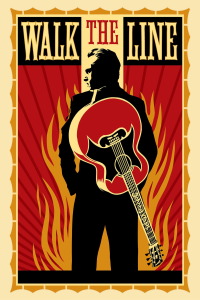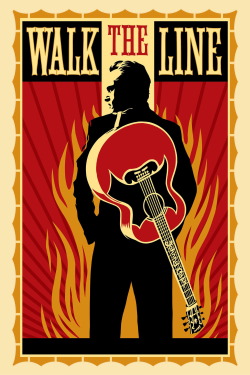
Review of Walk the Line (2005) by Markb. — 15 Dec 2005
It's as predictable a sign of autumn as football, falling leaves and hot chocolate and just as comforting: the annual highly-touted, loaded-for-Oscar-bear musical biopic of the life and troubled times of a much-loved, seminal rock figure that your parents are more familiar with than you are, though if the movie's good, it could change that.
(Next year or the year after that, how about a Chuck Berry movie starring one of the few current actors who can pull off playing ages 20 through 70: Sam Jackson?) It's interesting to note the schematic similarities in the life stories of last year's subject Ray Charles and this year's, Johnny Cash: both rose from childhoods that were beyond poverty-stricken; both were haunted by guilt arising from a brother's death that neither was at all to blame for, and the pressures of fame and fortune frequently turned both into seemingly unredeemable s.
O.b.'s, even if you leave drugs and alcohol out of the equation. Ray, featuring Jamie Foxx's justly lauded impersonation-and-beyond, was a very satisfying entertainment but Walk the Line, if anything, is slightly more so.
James Mangold's direction is a bit more meat-and-potatoes and a lot less flashy than Taylor Hackford's of the 2004 film, and that's a good thing: Cash's persona and story are so compelling that they don't need hokey 50's-style montages (Ray's biggest weakness) depicting his rise to the top.
Mangold (Cop Land, Identity) gives his film a leisurely pace, allowing it to build its own momentum, and rightly focuses on its two wonderful central performances: Reese Witherspoon's run of sometimes negligable romantic comedy fluffballs may actually have contributed to the real tension she brings to the role of June Carter, Cash's performing partner, collaborator and best friend whom he wants to become Something More.
And Joaquin Phoenix, who specializes in playing extremely naive or innocent souls (Ladder 49, Signs, Return to Paradise) brings a toughness and world-weariness to Cash that I didn't know Phoenix had in him.
(He also accomplishes the remarkable sequential feat of allowing Cash's famously growly speaking and singing voice to grow and evolve over the years rather than emerging with it full-blown from puberty onward.
) Walk the Line hasn't been marketed to the recently-tapped Christian moviegoing community with the aggressiveness of Chronicles of Narnia, and perhaps it should've, but then even though Cash had a solid churchgoing background and kicked various habits later in life largely due to Christianity, the pull and fascination of the dark side throughout his life seems at times to be almost as strong as it was for Anakin Skywalker; you can almost see the little angel and devil miniatures of Cash sitting on his shoulders.
(I find it striking and revealing that Cash, near the end of his life, invited Phoenix to dinner at his home...and proceeded to stun the actor by quoting Phoenix's dialogue as evil ruler Commodus in Gladiator line by line.
) The honesty with which Walk the Line depicts the married Cash's largely emotional affair with June (a situation that ANYONE who's endured an unrequited crush on a coworker can very easily identify with), and the toll it takes on Cash's marriage is admirable; not only does it refuse to make his wife (Gennifer Godwin) a villainess or justify his neglect of her, but her lament to Cash that he gave her everything but himself comprises the movie's most poignant scene.
Walk the Line clearly and rightly admires Cash's abundant songwriting and performing genius and his ability to overcome both circumstantial and self-inflicted tribulations, but doesn't sugarcoat or whitewash any of his behavior, and in the end, I think that's precisely the way that the 'Man in Black' would've wanted it.
This review of Walk the Line (2005) was written by Markb. on 15 Dec 2005.
Walk the Line has generally received very positive reviews.
Was this review helpful?