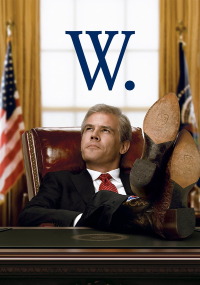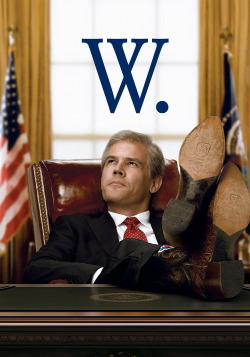
Review of W. (2008) by David P — 17 Jun 2010
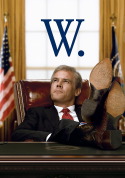
Surprisingly soft-pitch biopic of the most polarizing President in modern United States political history. The fact that this is the same director behind such controversial films as "J.F.K." and "Platoon" makes it even more inexplicable.
Stone's film tries to cover a lot of ground, even taking us though "Dubya's" formative years as a carousing frat boy, his abandoned career paths, and issues with drugs and alcohol. At first you can't help but regard George Jr.
as a brash, dim-witted, obnoxious cut-up, but then something miraculous happens: Stone manages to generate some sympathy for the guy. The film opines that the relationship between W. and his senior was quite adversarial.
W. is constantly being compared to younger brother Jeb and seems unable to crawl out from under the weight of his own family's legacy. In fact, it's not until his father fails in his bid to get re-elected for a second term to office before W.
realizes his powerful patriarch is fallible after all. This gives him the confidence boost he needed to make a drive towards the presidency. Which I believe it the film's main thrust that Bush sought election to the most powerful seat of office in the world not because he thought he was good for the job but because he wanted to impress Daddy.
In retrospect, this seems just as valid a motivation as any and also explains why things didn't turn out very well. Although I was upset that obvious and quite damning elements were either glossed over or jettisoned (such as Bush's connections to the creepy "Skull and Bones" society, details of election-rigging and his reactions to 9/11) I also feel as if I've gained a tad more insight into the man's motivations.
For example, in an early scene, W. looses a bid for Congress to a zealous, local Democrat, forcing him to make a vow "never to be out Christian-ed and out-Texan-ed ever again." You also get the impression, that Bush really meant well in his presidency but was led horribly astray by conservative extremists who used their superior knowledge of geo-politics to act on their desires for a "new world order".
Perhaps the most chilling scene is when W.'s advisers are making the case for invasion in Iraq. Dick Cheney (Richard Dreyfus) points out quite cynically that 40% of the world's oil traffic flows through the Persian Gulf and the world will soon reach peak oil production.
When Russia and China emerge as major consumers of oil and gas, Cheney posits that the invasion of Iraq is not just a move designed to bring freedom to Iraqis and stabilize the region but to ensure America's economic future.
His line or reasoning is coldly logical and you can almost see why Bush caved into this illusion of superior authority on the matter. Speaking of Dreyfus, the performances are generally stellar, especially from those actors that made an effort to embody their characters versus doing a "SNL"-style impersonation.
Dreyfus is amazing and you always have the impression that he's working on his own nefarious motivations just under the surface. Josh Brolin does a fantastic job capturing Bush's mannerisms and tics.
The scene where he faces a scrum or reporters is appropriately squirm-inducing. James Cromwell as Bush comes across as a human house of cards who's harsh appraisal of his son conceals his own personal weakness.
Here's a perfect example of what a disaster it could have been if had he engaged in some sort of Dana Carvey-like impression of Bush Senior. Jeffrey Wright's take on Colin Powell is a bit labored but his frustrations are clearly evident and well communicated.
The ladies also acquit themselves very well. Ellen Burstyn continues to amaze with a nuanced interpretation of Barbara Bush. She's tough, maternal and sensible, often acting as a mediator and staunch defender of her family.
The always-fetching Elizabeth Banks is a real wonder as Laura. I've always regarded the real-life Laura Bush as a non-entity: an incessantly grinning sleeping pill in a pantsuit. Whether it's accurate or not, Banks manages to make Laura seem supportive, empathetic and attractive while remaining generally removed from the trials of her husband.
Only Thandie Newton's cartoonish take on Condoleezza Rice seems out of place and borders somewhat on parody. Director Oliver Stone does a fine job keeping the threads of his story straight, which is quite challenging in a film that flips back and forth along the time line.
His recurring use of the outfielder dream/nightmare makes for an effective tool to flash-sketch Bush's state of mind at any one time. Despite this technique, I really didn't feel as if I got to know George W.
Bush all that well. The script dictates that a lot of things happen to him like a resume checklist but we really don't get to witness the internal examinations that should result. My biggest issue with the film, however, is that it just doesn't go far enough, even stopping abruptly just as W.
was catching major heat for the insurgency swell in Iraq. It's almost as if Stone didn't want to be accused of "piling on" or being too partisan on the issue. Although I was unexpectedly forced to view this oft-vilified man's story from different perspective, the film itself is non-committal and woefully underwhelming when it should have been the biopic equivalent of a Texas brush fire.
Tilt: down.
This review of W. (2008) was written by David P on 17 Jun 2010.
W. has generally received mixed reviews.
Was this review helpful?