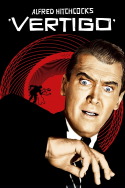
Review of Vertigo (1958) by Chris H — 11 Aug 2014
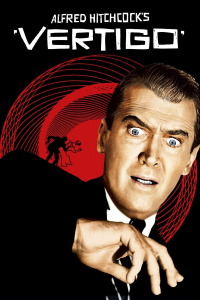
The 50's to the 60's was arguably Hitchcock's most daring period. Hinting at suppressed homosexuality ("Strangers on a Train"), finding the darkly comic situation of the inability to keep a corpse buried ("The Trouble with Harry") and focusing on humans voyeuristic instincts ("Rear Window" and "Psycho"), it seems Hitchcock was fascinated by making audience identify with their repressed desires. And while these previous mentioned films were all Hitchcock classics, "Vertigo" still remains the autuers most mysterious and possibly, most complex.
The narrative primarily focuses on detective John 'Scottie' Ferguson (James Stewart) who comes out of retirement to help investigate the mysterious activities surrounding an old friends wife. While this may sound conventional thriller territory, there is a sense of mystery (and elements that borderline the supernatural) that add a great sense of intrigue to the narrative. Furthermore, Hitchcock's direction perfectly contributes to films mysterious nature. In a much celebrated passage (evoking the directors notion of 'Pure Cinema'), Hitchcock substitutes dialogue and lets the narrative unfold through visual imagery and Bernard Herrmann's score. However, most importantly during this sequence, Hitchcock situates us in Scottie's voyeuristic position so just like the detective himself, the audience also become obsessed and intrigued with the enigmatic Madeline Elster (Kim Novak). And while this sequence is often the most referenced, throughout "Vertigo" there are continues reminders of Hitchcock's virtuoso capabilities with a camera: from the beautiful imagery of San Francisco, perfect frame compositions, hyper-stylized visuals and of course the birth of the 'Vertigo Shot.'.
In relation to character dynamics, "Vertigo" would have be Hitchcock's most - in terms of emotion - significant. In many of his films, Hitchcock usually has characters that represent idealized constructions of gender that usually have a charming and playful chemistry. Although we see this Hitchcock archetype initially (the relationship between Scottie and Midge [Barbara Bell Geddes]), the dynamic that eventually follows is the directors most melancholic and tragic. To watch Scottie, after losing his idealized vision of love (a women who does not exist) attempting to recreate elements of the past demands all sympathy from the audience. More importantly, while Scottie is the essential victim, Hitchcock makes Scottie's conflict so much more interesting by blurring the distinctions between perpetrator (Judy) and victim (Scottie) which in turn allows the audience to not only feel sympathy for Scottie, but also for Judy's internal torment. By the time we reach the final conclusion, the audience is torn between sympathizing for both fragmented figures.
Although "Vertigo" undeniably represents Hitchcock as a director at the top of his game and some of his most powerful character dynamics, it really is the subject matter that makes the narrative such a complex tale. Released directly before the 'New Hollywood' period, it is astonishing how much the film, thematically, focuses on morbid notions. As suggested with the characterization of Madeline, there are times where her character reflects the inevitability of death. Considering that the film was made during the late 50s, in a time of paranoia and the possibility of nuclear extinction, it is quite obvious to see how the subject matter is audacious (and possibly why it failed at the box-office). If these concepts were not disturbing enough, the second half of the tale and the depiction of Scottie's obsession and idealism and attempts to recreate past desires through Judy Barton (Kim Novak) with a complete disregard to her internal conflicts is simultaneously tragic and disturbing (James Stewart's acting abilities in conveying this fine line is truly amazing). And beyond all this, Hitchcock continually manipulates the visuals, implores certain lighting techniques and interesting interchanges between omnipresent and POV positions that all contribute to the dream-like quality of the film (to the point where Scottie's 'reality' is put into question). Considering all these notions (and there are many I have not mentioned such as identity politics, masculine romanticism, the impotency of masculine stereotypes and the interchange between the past and the present), "Vertigo" could quite possibly be Hitchcock's most richest film.
Many say that Hitchcock, when making movies, always considered the audiences expectations. For his other films, this is undeniably true. However, as many have noted (even the director himself), "Vertigo" is the autuers most personal effort. And while initially critics critiqued Hitchcock for being self-indulgent, this indulgence created the layers upon layers within film that add to its everlasting intrigue and like Scottie himself, after repeating viewings it is hard to not become obsessed with "Vertigo" mysterious nature.
This review of Vertigo (1958) was written by Chris H on 11 Aug 2014.
Vertigo has generally received very positive reviews.
Was this review helpful?