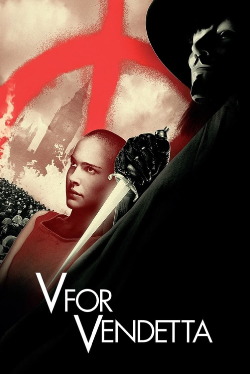
Review of V for Vendetta (2006) by Ola G — 20 Nov 2017
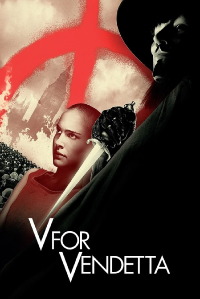
In 2027, the world is in turmoil and warfare, with the United States fractured as a result of prolonged second civil war and a pandemic of the "St. Mary's Virus" ravaging Europe. The United Kingdom is ruled as a fascist police state by the Norsefire Party, helmed by all-powerful High Chancellor Adam Sutler (John Hurt). Political opponents, immigrants, Jews, Muslims, atheists, homosexuals, and other "undesirables" are imprisoned and executed in concentration camps. On November 4, a vigilante in a Guy Fawkes mask identifying himself as "V" (Hugo Weaving) rescues Evey Hammond (Natalie Portman), an employee of the state-run British Television Network, from members of the "Fingermen" secret police while she is out past curfew. From a rooftop, they watch his demolition of London's main criminal court, the Old Bailey, accompanied by fireworks and the "1812 Overture". Inspector Finch (Stephen Rea) of Scotland Yard is asked to investigate V's activities while BTN declares the incident an "emergency demolition". V interrupts the broadcast to claim responsibility, encouraging the people of Britain to rise up against their government and meet him on next year's Guy Fawkes Night outside the Houses of Parliament. During the broadcast, the police attempt to capture V. Evey helps him escape, but is knocked unconscious. V takes Evey to his home, where she is told she must remain for one year. V then kills Lewis Prothero, Norsefire's chief propagandist, and Anthony Lilliman, the Bishop of London. Evey offers to help, and uses the opportunity to escape to the home of her boss, comedian and talk show host Gordon Deitrich (Stephen Fry). In return for Evey trusting him with her safety, Gordon reveals prohibited materials, including subversive paintings, an antique Quran, and homoerotic photographs. Meanwhile, V confronts Dr. Delia Surridge, who had experimented on him and many other "undesirables" 20 years ago at Larkhill concentration camp; seeing her remorse for her past actions, he kills her painlessly. After Gordon performs a satire of the government on his show, his home is raided and Evey is captured. She is imprisoned and tortured for information about V, with her only solace being a note written by actress Valerie Page, a former prisoner who was tortured and killed for her lesbianism. Evey is told she will be executed unless she reveals V's location. When she says she would rather die, she is inexplicably released, and then finds herself in V's home. It turns out that V was the one who had "captured" her at Gordon's home, and staged her imprisonment and torture to free her from her fears. The note was real, passed from Valerie to V when he was imprisoned. He also informs her that Deitrich had been executed when the Quran was found in his home. While Evey initially hates V for what he did to her, she realises she has become a stronger person. She leaves him, promising to return before November 5. Reading the deceased Surridge's journal, Finch learns V is the result of human experimentation and has been targeting the people who detained him. Despite being stonewalled by the government, Finch searches for the true identity of V, tracing him to a bioweapons program in Larkhill. Finch meets William Rookwood, who tells him that the program, which was directed by Sutler (who was then Undersecretary of Defence), resulted in the creation of the deadly St. Mary's Virus. He further reveals that Creedy, a leader of the Norsefire Party, released the virus onto English soil, killing 100,000 British residents and framing the outbreak as an attack by a terrorist organisation. The Party, which promised security in times of social instability, used the ensuing wave of fear to elevate Sutler to the newly created office of High Chancellor and win an overwhelming majority in Parliament, becoming the elected government. Finch later discovers the man he met was V in disguise, and though he initially disbelieves the story, his faith in the Norsefire government is severely shaken. As November 5 nears, V distributes thousands of Guy Fawkes masks, and the population questions party rule as the nation slowly descends into anarchy, ignited when one of the Fingermen makes the mistake of shooting and killing a young girl committing vandalism, only to be killed in turn by a mob of enraged citizens. On the eve of November 5, Evey visits V, who shows her an explosive-laden train in the abandoned London Underground, set to destroy Parliament. He leaves it to Evey to decide whether to use it...
Ebert and Roeper gave the film a "two thumbs up" rating. Roger Ebert stated that V for Vendetta "almost always has something going on that is actually interesting, inviting us to decode the character and plot and apply the message where we will". Margaret Pomeranz and David Stratton from At the Movies stated that despite the problem of never seeing Weaving's face, there was good acting and an interesting plot, adding that the film is also disturbing, with scenes reminiscent of Nazi Germany. Jonathan Ross from the BBC blasted the film, calling it a "woeful, depressing failure" and stating that the "cast of notable and familiar talents such as John Hurt and Stephen Rea stand little chance amid the wreckage of the Wachowski siblings' dismal script and its particularly poor dialogue." Sean Burns of Philadelphia Weekly gave the film a 'D', criticizing the film's treatment of its political message as being "fairly dim, adolescent stuff," as well as expressing dislike for the "barely decorated sets with television-standard overlit shadow-free cinematography by the late Adrian Biddle. The film is a visual insult." On Alan Moore removing his name from the project, Burns says "it's not hard to see why," as well as criticising Portman's performance: "Portman still seems to believe that standing around with your mouth hanging open constitutes a performance." Harry Guerin from the Irish TV network RTÉ states the film "works as a political thriller, adventure and social commentary and it deserves to be seen by audiences who would otherwise avoid any/all of the three". He added that the film will become "a cult favourite whose reputation will only be enhanced with age." Andy Jacobs for the BBC gave the film two stars out of five, remarking that it is "a bit of a mess... it rarely thrills or engages as a story.".
To re-see "V For Vendetta" was a bit unfulfilling as I honestly don´t think it´s not as good as I thought it was when it came out. I have never red Alan Moore´s thought-provoking graphic novel, but I know of it, and I think the plot and conceptual idea is quite intriguing. It´s complex, tense in a way, layered and you can´t but cheer for the anti-hero V despite some of his actions that are as vile as the methods the government he despises use. The main focus is fear and how the government use it as a weapon to control and make sure that people do what they are told. And the antidote is vengeance via V and his methods. The problem here is that even if "V For Vendetta" is based on a graphic novel it somehow becomes too cartoony for its subject matter and you struggle with buying into this futuristic society and its protagonist. The problem is as well the editing, the acting is not always spot on (specifically Natalie Portman is not convincing in her role as Evey and the overacting from for example John Hurt was not of my liking) and the comical structure that appears at certain points in the film doesn´t work but rather create an unbalance. You simply feel disappointed when the film is over.
Trivia: The original comic series was originally created by Alan Moore. However, following his negative experience with From Hell (2001) and The League of Extraordinary Gentlemen (2003), Moore decided to reject all money and credit from Hollywood on any adaptations of his work. Thus, he gave all the money he would've gotten to the artist who drew the character with him, and rejected his own "created by" credit from the film.
V wears a mask in the guise of Guy Fawkes, who is most famous for his involvement in the Gunpowder Plot of 1605, which he was placed in charge of executing, due to his military and explosives experience. The plot, masterminded by Robert Catesby, was a failed attempt by a group of provincial English Roman Catholic conspirators to kill King James I of England (the Sixth of Scotland), his family, and most of the Protestant aristocracy in one swoop, by blowing up the Houses of Parliament during its State Opening.
Alan Moore, writer of the original graphic novel, greatly disliked the film, criticizing the script for "having plot holes you wouldn't have gotten away with on Wizzer and Chips in the 1960s". He ended cooperation with his publisher, DC Comics, after its corporate parent, Warner Brothers, failed to retract statements about Moore's supposed endorsement of the film. Joel Silver said at a press conference that Lana Wachowski had talked with Moore, and that "Moore was very excited about what Lana had to say." Moore disputed this, reporting that he told Wachowski "I didn't want anything to do with films. I wasn't interested in Hollywood," and demanded that DC Comics force Warner Brothers to issue a public retraction and apology for Silver's "blatant lies". Although Silver called Moore directly to apologize, no public retraction appeared. Moore was quoted as saying that the comic book had been "specifically about things like fascism and anarchy. The words 'fascism' and 'anarchy' occur nowhere in the film. It's been turned into a Bush-era parable by people too timid to set a political satire in their own country." This conflict between Moore and DC Comics was the subject of an article in The New York Times on March 12, 2006, five days before the U.S. release. In the New York Times article, Silver stated that about twenty years prior to the film's release, he met with Moore and David Gibbons when Silver acquired the film rights to V For Vendetta and Watchmen. Silver stated: "Alan was odd, but he was enthusiastic and encouraging us to do this. I had foolishly thought that he would continue feeling that way today, not realizing that he wouldn't." Moore did not deny this meeting, nor Silver's characterization of Moore at that meeting, nor did Moore state that he advised Silver of his change of opinion in those approximately twenty years. The New York Times article also interviewed David Lloyd about Moore's reaction to the film's production, stating, "Mr. Lloyd, the illustrator of V for Vendetta, also found it difficult to sympathize with Mr. Moore's protests. When he and Mr. Moore sold their film rights to the comic book, Mr. Lloyd said: "We didn't do it innocently. Neither myself nor Alan thought we were signing it over to a board of trustees who would look after it like it was the Dead Sea Scrolls.".
This review of V for Vendetta (2006) was written by Ola G on 20 Nov 2017.
V for Vendetta has generally received very positive reviews.
Was this review helpful?