Review of Us (2019) by Bertaut1 — 31 Mar 2019
An effective socio-political thriller looking at issues of class and privilege.
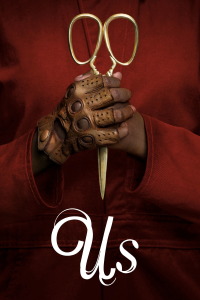
There's a detail to be found in writer/director Jordan Peele's second feature, Us, which gives you a good idea of the amount of thought that has gone into the film. In the opening scene, set in 1986, a young girl walks into a hall of mirrors, with a sign outside proclaiming "Find yourself", and a picture of a Native American above the door. Later in the film, now in the present day, the same hall of mirrors is seen, the same "Find yourself" is seen, but now the picture of the Native American has been replaced with a wizard. This change represents a meaningless and superficial attempt to tackle society's discomfort with its violent history, and this, in turn, speaks directly to one of the film's most salient themes - the US (or us) is a country built on violence, racism, and oppression, but as long as such things are swept under the carpet and no one talks about them, then there's no need to worry. Peele very much wants people to start talking about them.
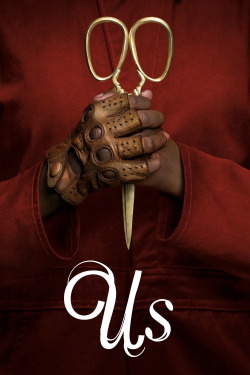
The film tells the story of the Wilson family - Adelaide (an astounding Lupita Nyong'o), Gabe (Winston Duke), Zora (Shahadi Wright Joseph) and Jason (Evan Alex) - who one night whilst vacationing in Santa Cruz are confronted by their violent doppelgängers.
One of the problems with parsing the film is that so many of the socio-political themes are tied to who the doppelgängers are and what they want, that it's difficult to discuss them without spoilers. So, small spoiler ahead - the doppelgängers are called the Tethered; essentially, they are an underground-dwelling race of lookalikes. Through no fault of their own, they are deprived of the opportunities those above the surface have access to. The allegorical dimension couldn't be clearer; the film is a parable about class division. The Wilsons represent a middle-class all-American family; the Tethered represent the underclass, those without access to privileges, despite possessing the same capacity for happiness and success. This similarity is driven home when Adelaide asks Red (her Tethered) who they are, and Red answers (truthfully), "we're Americans.".
In this sense, the film is very much about marginalisation. And this speaks to perhaps the film's most important point - the destitute and discriminated against can succeed just as much as everyone else if only they're given the opportunity to do so. This is also alluded to in the powerful final shot, which reveals that the Tethered have accomplished something which the surface dwellers once attempted but failed. The Tethered are the ignored, those swept under the rug of society, just like the alteration to the picture above the hall of mirrors. True, the deeper Peele explores the Tethered, the more insurmountable logistical problems are thrown up, and the further he strains credibility. However, this is not as detrimental as it may sound.
Even more so than Get Out, Us is aesthetically gorgeous, with Mike Gioulakis's cinematography especially impressive. An illustrative scene features the rare use of a split diopter, a tool favoured by Brian De Palma that allows both foreground and background subjects to stay in focus simultaneously. Using it in a crucial scene towards the end of the film, it is the only time we see Adelaide and Red's faces in the same shot at the same time, with Red shot in BCU, facing away from Adelaide, who stands behind her.
In terms of acting, Nyong'o's nuanced work as Adelaide and Red is a clinic in contrasts. Apart from their appearance, nothing about the two is similar; their posture, their facial expressions, how they talk, how they walk, how they react to things around them, how they use their hands. Adelaide, a former ballet dancer, is graceful and elegant, whereas Red is automaton-like, her movements almost staccato.
As for problems, there are a few. Aside from the insurmountable practical issues with the Tethered, my biggest issue was that every time the Tethered want to kill someone, they do so immediately. However, they pass up multiple opportunities to kill the Wilsons, which is an irritating inconsistency. Additionally, the final twist doesn't really work, feeling like something of a twist for twist's sake that was never fully integrated into the narrative.
These small problems notwithstanding, Us is an impressive film that improves on Get Out in almost every way, and which serves as a more complete artistic statement. The Tethers are monsters because they have been left with little choice other than to become monsters, imprisoned by a system they had no part in creating and in which they are not allowed to participate. In Get Out, Peele took a story of bodily possession and moulded it into a story of black/white relations. In Us, he demonstrates that oppression can easily cross racial boundaries. And the real horror of this is to be found in humanity's inhumanity to one another.
This review of Us (2019) was written by Bertaut1 on 31 Mar 2019.
Us has generally received very positive reviews.
Was this review helpful?