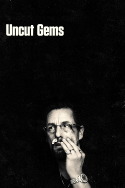
Review of Uncut Gems (2019) by Bertaut1 — 24 Jan 2020
Watching a guy screw up for two frantic hours may not sound very compelling, but this is a fine piece of work.
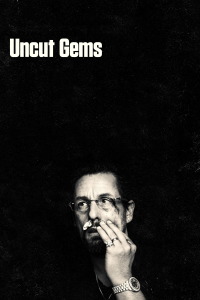
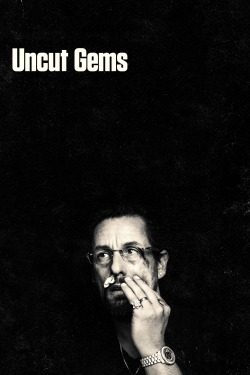
Written by Ronald Bronstein, Josh Safdie, and Benny Safdie, and directed by the Safdies, Uncut Gems is two hours and fifteen minutes of watching a guy screw up in increasingly spectacular and catastrophic ways. It's a film where you're on edge from the first act. It's a film that never stops moving at the chaotic breakneck speed with which it begins. It has also been made with such craft, the mise en scène is so good, the dialogue so sharp, and the acting so intense, that you may as well be watching a fly-on-the-wall documentary. It's a film made of pure sweat and anxiety, and I'd highly recommend it.
New York, 2012. Howard Ratner (Adam Sandler) is a jeweller who lives his life on the principle of robbing Peter to pay Paul. A serious gambling addict, soon after we meet him, it's revealed he's currently in debt to his loan-shark brother-in-law Arno (Eric Bogosian) to the tune of $100,000. Meanwhile, when his store is visited by Boston Celtics' basketballer Kevin Garnett (a surprisingly strong performance by Garnett himself), Howard reveals that he has smuggled an ultra-rare black opal of extraordinary translucence into the country for an auction the following day, where he expects it will sell for up to $1 million. However, when Garnett sees it, he insists he is allowed to have it as a lucky charm, just for the match he's playing that night. Howard is reluctant but agrees to part with it when Garnett offers to leave his All-Star ring as collateral. And, predictably, things quickly go awry.
Howard is a delusional and doomed figure who genuinely believes that his big score is right around the next corner, a fantasist who's utterly divorced from reality, a man who believes completely that if people would get out of his way and let him turn that fabled corner, all of his worries will disappear. It's the gambling addict's fallacy – no matter how much or how often you lose, the next bet will be the big winner. In this sense, the film is an astute study of addiction, although this theme is never foregrounded. Howard is hopelessly consumed by his addiction (although never once does he give the impression that he wants to stop gambling). And this is why delusion is such a major component in his psychological make-up – addiction and delusion form an ever-tightening feedback loop that becomes more difficult from which to escape, the more self-sustaining it becomes.
In terms of aesthetics, it's worth noting that two of the three writers (Bronstein and Benny Safdie) are also credited as the editors, and this is crucial insofar as the frenetic pace of the narrative is ingrained into the script – this is a film written by people with one eye on the editing rhythms. The first scenes in New York, for example, immediately establish the chaotic energy – dialogue overlapping almost unintelligibly as multiple characters interact and talk over one another, at least three things always happening. The opening scenes establish the pace as blistering, and that never really changes. The score, by Oneohtrix Point Never, is also excellent. Obviously inspired by Tangerine Dream's electronic scores for Michael Mann's early films, most notably Thief (1981), it's a crucial element of the film, adding to the overlapping cacophony of sound and enhancing the general sense of twitchy chaos.
As for the acting, everything you've heard about Sandler is true; he's incredible. Sure, he's playing the same kind of volatile delusional loser that he's played in a million-and-one subpar comedies. But it's the tone of the performance, the key in which he plays Howard that makes it stand out; the inherent tragedy of the man, his self-delusion, his seemingly unquenchable optimism – Sandler draws these elements out every second he's on-screen. Elsewhere, Bogosian is his usual stoically intimidating self; as Howard's wife Dinah, who has grown to loathe her husband, Idina Menzel manages some of the most withering looks ever captured on film; and as his naive but sweet mistress Julia, debutant Julia Fox imbues what could have been a clichéd bimbo role with real emotional nuance.
As for problems, the pace of the film will certainly put some people off. There are no down-moments here, no scenes designed to let the audience breath. Partly because of this, the tone never really varies. There are some comic beats (Howard getting dumped naked into a car trunk during his daughter's school play is particularly funny), but by and large, the tone is dark, ominous, and exhausting. And there will, of course, be people who just can't get past the presence of Adam Sandler, which I can understand. Personally though, I loved Uncut Gems. It's certainly not the subtlest of films, nor the most thematically complex, but as character studies go, this is exceptionally good work from everyone involved and a genuinely unique piece of cinema.
This review of Uncut Gems (2019) was written by Bertaut1 on 24 Jan 2020.
Uncut Gems has generally received very positive reviews.
Was this review helpful?