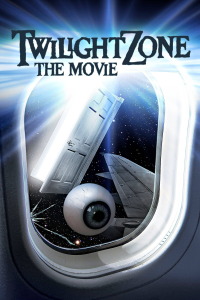
Review of Twilight Zone: The Movie (1983) by R.c. K — 02 Sep 2008
Some movies are saddled with a need to honour respected source material. Some are saddled with a dark history (see also: The Dark Knight, The Crow...) in reality. In the case of the Twilight Zone movie, both are a problem. The deaths of Vic Morrow, Renee Chen and My-ca Dinh Lee are often suspected in communities interested in the movie of being the reason the film was not released on DVD for such a long period of time. Certainly it didn't gain a reputation that let people see past such tragedy, either--it was often thought of as a poor, modern update of the original show, and a generally iffy (or even bad) movie. Spielberg was criticized for being incontrovertibly sentimental and saccharine, and the rest for being inferior to their original television incarnations--and then Landis' segment for being nowhere near artistic gain from such a loss. Expectations, certainly, were likely at fault, too. With four directors riding chairs for the film who were experiencing great appreciation at the time--Steven Spielberg, Joe Dante, John Landis, and George Miller--a set of actors who were well thought-of by and large, even if not absolutely huge names at the time. I, of course, saw the movie without really knowing any of these names, or at least not knowing how to associate them. I refer not, of course, to the viewing that is behind this review, but my first one.
The film opens on what is probably the most well-known part of the movie, the wraparound that is not based on an episode. Albert Brooks is driving Dan Aykroyd around an abandoned road in the middle of the night, listening to Creedence Clearwater Revival's "Midnight Special" until his tape deck eats the tape. Then, to find something to do, they play "TV Theme Songs"--scatting, singing and humming theme songs to get the other to guess the show behind it. They hit upon The Twlight Zone and then discuss a few episodes, eventually leading in to "scary" tricks and gags on Brooks' part--with Aykroyd's infamous response: "Wanna see something really scary?".
And there on we enter the full segments. First there is the truncated--for obvious reasons--Landis/Morrow segment, where Bill Connor (Morrow) is a racist ranting about the destruction of America, who wanders outside to find himself in the position of persecuted racial minorities from Nazi Germany to a swampy jungle in Vietnam. Morrow's deep, gravelly voice firmly anchors his character as a working everyman sort of racist, one that is recognizable, and with Landis' dialogue managing the line between realistic racism and cinematic exaggeration (because racism is of course usually too subtle to see so clearly, especially of so many races at once). His friends Ray (Charles Hallahan) and Larry (Doug McGrath) show an "appropriate" level of uncomfortable acceptance of Bill's behaviour for friends with such a man. They make half-hearted attempts to calm him down, especially when another patron of the bar he's ranting in (Steven Williams, later The X-Files' X) suggests Morrow may wish to shut his mouth--but without being threatening in an ironically stereotypical way. Some feel the segment does not hold up--some saying so in light of what came of it, others because of the ending that was lost for the same reason. I've always felt it held up rather well as a dark Zone-style ending.
The second segment is Spielberg's maligned "Kick the Can," starting the last three stories off on the trend of adaptation of pre-existing episodes. Mr. Bloom (Scatman Crothers, who I always hear saying, "Jazz to Moonbase Two! Jazz to Moonbase Two!" in my head) wanders into the Sunnyvale Rest Home, where Leo Conroy (Bill Quinn), Mr. (Martin Garner) and Mrs. (Selma Diamond) Weinstein, Mrs. Dempsey (Helen Shaw), Mr. Agee (Murray Matheson) and Mr. Mute (Peter Brocco) all live. Many are depressed by their existence, when Mr. Bloom reminds them of youth, of playing games and dancing, and suggests they bring this youth back to their lives, but Conroy alone rejects this and insists they act their age. The segment is as saccharine as many say, allegedly intentional to counter the darkness behind the film's production. It works, with good performances from all involved, especially the Morgan Freeman-pre-dating "magical black man" role for Scatman, whose peculiar voice manages to carry the perfect elements of light-hearted scolding for the age-centric thinking of the people he's trying to help. But "working" is most of what's to be said for it--it's not terribly interesting overall.
The third segment is "It's a Good Life," where schoolteacher Helen Foley (Kathleen Quinlan) stops in a diner for directions (from barman Dick Miller, telling us this is Joe Dante's segment, and also that the barman is pretty much cooler than everyone else in the movie, by virtue of being Dick Miller) where a boy, Anthony (Jeremy Licht), is playing an arcade game, hitting it angrily as it malfunctions, causing the television in the bar to flicker to snow.* When Helen leaves, she nearly backs over Anthony, who asks her for a ride home because she has totalled his bike. There she meets Uncle Walt (Kevin McCarthy, further increasing the awesome quotient of this segment), Mother (Patricia Barry), Father (William Schallert) and Ethel (Nancy Cartwright--yes, the voice of Bart). At first they seem sort of odd, but eventually their cracks begin to show and we realize just how paranoid they are, how absolutely terrified and desperate to survive--and why. It's by far the most imaginative and, well, interesting, of the segments, with some fantastically bizarre sequences and effects. Licht does quite well in his role--I often watch child actors with a great scrutiny, as they tend toward being either incalculably awful or irritatingly pretentious, believing themselves fullgrown adults without realizing their characters are not supposed to be like that.
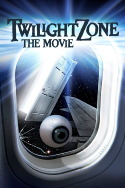
The final segment is probably the best reviewed--John Lithgow revives a role originally performed by Bill Shatner, a man afraid of flying who stresses over the flight he's on, worrying constantly, attempting to calm himself with statistics, but sweating and shaking constantly, fearing the slightest bump and mentally exaggerating all sounds and feelings. When he's finally relatively calm thanks to passengers and attendants, he glances out the window to see the shape of a man, instantly returning him to an incurable panic, first for the man's safety and then for his true intentions in being out there--with, of course, no one else on the plane believing what he claims to see. Lithgow is dynamic and exciting, creating a palpable tension, even in someone like myself, who has never feared flying, found it primarily boring even. His mortal fear and endless paranoia manage to avoid irritation of the viewer because he makes himself sympathetic enough that we can't help but feel sorry for his endless worries.
The film really is quite good, as it happens. No segment doesn't work, and by and large they are enjoyable--even Spielberg's is actually enjoyable, even if it's not all that interesting. I've always liked it and it continues to hold up, especially the effects (thankfully all physical and pre-CGI!).
*Of course, watching said TV is none other than Bill Mumy, who originally played Anthony in the television show--as well as being the young lead of Lost in Space and half of bizarre musical group Barnes & Barnes, responsible for that lovely mass of insanity that is the song "Fish Heads.".
This review of Twilight Zone: The Movie (1983) was written by R.c. K on 02 Sep 2008.
Twilight Zone: The Movie has generally received mixed reviews.
Was this review helpful?