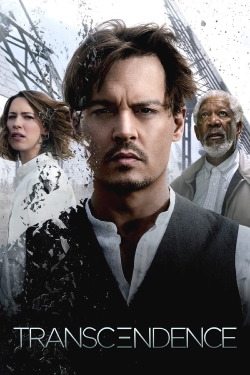
Review of Transcendence (2014) by Jack F — 05 Aug 2016
An anomaly like this happens every now and again. A movie will come out, get savaged by critics, and bomb at the box office. Then I'll stumble across it by happenstance a couple years later and...end up loving it. (A recent example of this would be "Terminator Genisys," but you could trace this back to movies like "The Cable Guy" and "The Frighteners" too.).
Such is the case with "Transcendence," the 2014 sci-fi film that marked the directorial debut of Wally Pfister, the ace cinematographer best known for his Oscar-nominated work in many of Christopher Nolan's films. The movie had so many factors in its favor-a great cast led by one of the biggest movie stars in the world, a director with a sharp eye for visual flair, an intriguing, thought-provoking storyline-that it's sort of puzzling to try and figure out exactly what went wrong here.
Perhaps it was mis-marketed? That might explain its poor box office receipts, and to be honest, it doesn't really surprise me that this wasn't a big hit commercially. It can be hard for films with heady, sci-fi themes (non-action based ones, at least) to find a wide audience. But the critics? Their overwhelmingly negative response kind of surprises me. I feel like they just missed the boat on this one, as I found "Transcendence" to be an intelligent, beautifully shot movie that encompasses many different genres. The chief one is undoubtedly sci-fi, but there are elements of a thriller, a film noir, a love story, a heart-breaking tragedy, a cautionary tale, and even a touch of horror. Admittedly the film's overall message is something that's been done dozens of time before, but that's not to say "Transcendence" doesn't have some interesting ideas.
Johnny Depp stars as Dr. Will Caster, a renowned scientist who has been working for years on creating a sentient form of artificial intelligence. He believes that such a breakthrough will take mankind to new technological heights, completely altering human civilization for the better. His beliefs are not universally shared, however, particularly by an underground terrorist group known as R.I.F.T. ("Revolutionary Independence From Technology"), which operates on the principles that man has become too reliant on technology. Therefore, they view the implications of Will's research as especially dangerous, and they successfully stage an attack that leaves the scientist at death's door.
With no options left, Will's wife (Rebecca Hall) and best friend (Paul Bettany) come up with a desperate plan: upload Will's consciousness, cognizance and knowledge-essentially, his entire mind-into the A.I. program he had already begun developing. The thought is that, with a human mind as a building block, they'll finally be able to create a form of A.I. that is truly self-aware; basically, it'd be a living, sentient computer program. Will would really be a man in the machine.
The transition appears to be successful as the program begins to speak in Will's voice and even recreates his appearance digitally. The program claims that it actually IS Will; after all, it was Will's mind that was transferred into the machine.
Ah, but is it actually Will? His wife is completely convinced that it is. Bettany's character is not so sure. Surely it can't be considered "human" if it has no flesh and bone body. But then again, is it our bodies that truly defines us as human? What about the other factors? What about our minds? Or, if you want to get spiritual, what about our souls? This iteration of Will Caster has a mind and, in a way, has a body. But a soul...
I don't really want to delve too much further into the plot. (Suffice it to say, like "The Terminator" or "The Matrix" or any other film involving A.I. getting a little too smart, things don't exactly go as planned.) But these are the kind of thoughts the movie encourages, and again, while it's definitely been done before, that doesn't lessen the experience. "Transcendence" is beautifully executed, finding a nimble balance between hard science fiction and existentialism. I've said it dozens of time before, but execution is the key to everything. And under the skilled eye of Pfister, the film delivers some hauntingly beautiful imagery.
In one of the movie's most refreshing touches, the climax occurs in a fashion you might not be expecting. The movie seems poised to go one way, which truthfully is the pretty clichéd route, but then ends up deviating in a manner I found most satisfactory. More than anything, the resolution just feels...human. Authentic. Organic. It doesn't feel like it's driven by the demands of the Hollywood machine. Kudos to writer Jack Paglen for bucking the trend here. With a film that keeps grappling with the notion of what it is to be human, I'm glad it ended in a way that seemed faithful to all that came before it.
Perhaps "Transcendence" will find a cult following in a few years. A few select elements of this particular film type are certainly there. But ultimately, I doubt it. It falls into that gray area of being too weird or deep for mainstream audiences, but not quirky enough to appeal to the fringe folks. But I'm certainly glad I came across it. In my opinion, it's definitely a forgotten, misunderstood gem.
This review of Transcendence (2014) was written by Jack F on 05 Aug 2016.
Transcendence has generally received mixed reviews.
Was this review helpful?