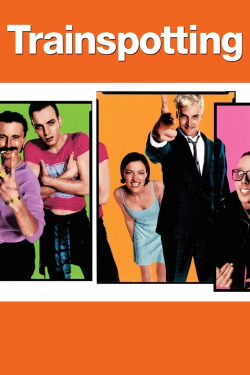
Review of Trainspotting (1996) by Blake P — 16 Dec 2015
Film is a safe place whereby we can escape our lives for the fictional counterpart of another. I'm most content slipping into the shoes of a Gene Kelly, a Steve McQueen, or a Humphrey Bogart, living as a hero in a world where I can do no wrong, where I look like a spectacular beaut in the eyes of a Cyd Charisse, a Jackie Bisset, or a Lauren Bacall. But others thrive when in the presence of agitated commotion - the number of people I've met whose lives were supposedly changed by something depraved like "Fight Club" or "Requiem for a Dream" is staggering. Part of them cringes, but another wants to live vicariously through the demented lives of danger magnetizing ne'er-do-wells.
"Trainspotting" seems to be a prime example of this. It has become a cult classic, but is inexplicably so. I can understand repeated viewings of a shlock-fests akin to "Evil Dead" or "Pink Flamingos" - those are definitively strange but also hold a sort of boundless fascination that makes each watching a unique experience. Yet I can hardly comprehend why anyone would want to see "Trainspotting" again, let alone consider it to be one of their favorite movies. Perhaps I sound as though I'm in the midst of forming a negative opinion - far from the truth: this is a compelling film - but that's only because I have a hard time understanding how something so warped, so dirtily realistic, can have a devoted following willing to endure the sum of its parts over and over again.
The film is, by now classically, renowned for being one of the most gritty glimpses into the world of heroin use. While "Trainspotting" does sometimes sport a dark sense of humor, we are never given the opportunity to turn a blind eye to much of the ugliness on display - consider scenes in which our protagonist practically dives into the toilet of an infamously dirty bathroom in Scotland for a couple of accidentally dropped hits, or another (spoiler) during which the baby of one of the minor characters tragically dies after prolonged neglect. It is disturbing, but also colossally riveting - Danny Boyle, its director, pulls no punches.
"Trainspotting" largely follows the life of Mark Renton (Ewan McGregor), a cowardly twenty-something who has devoted the majority of his adult existence to drugs. The high of a needle is of utmost importance; if presented with the decision to choose homelessness or heroin, he would, most likely, pick the latter. He is always surrounded by other addicts (Jonny Lee Miller, Ewan Bremner, Kevin Mckidd), most of whom consider the other a friend - but we aren't so sure the bond is due to healthy mutual liking but because of the relativity that flows between practitioners. They'd all trade each other for narcotics any day, without a doubt.
Shortly into the film, though, Renton takes it upon himself to get off smack, not necessarily because he's sick of it but because he's curious what will happen to him without it. He briefly lapses after a short offing, but cleanliness eventually overcomes him - he even transforms into a real-estate agent after a streak of sobriety. Demons, however, can be difficult to run away from, and it isn't long before the junkie friends he used to know start to show up on his doorstep and take him into the same land of needles and frameless mattresses once again.
"Trainspotting" moves around in a circle, never really having a beginning, middle, or an end because Renton will never stop living through the same cycle of going clean, finding slight life success, and relapsing with blatant repetition. I never felt wholly fulfilled by the film - it's too erratic to really grab you by the collar - but I was, nevertheless, invested in Renton (specifically), genuinely concerned about the future waiting ahead of him. McGregor gives the kind of performance that provides you with a fleshed-out individual, not a character boxed into a single film with resolute dimension.
But "Trainspotting" is no holds barred when exploring the nature of addiction, and for that, I applaud it. If it doesn't thoroughly appease my expectations, that isn't the film's fault; a movie reflecting the pitfalls of the disease can only be drawn in such a manner. And for the most part, Boyle has the brushes and pens necessary.
This review of Trainspotting (1996) was written by Blake P on 16 Dec 2015.
Trainspotting has generally received very positive reviews.
Was this review helpful?