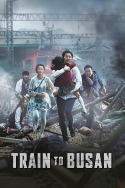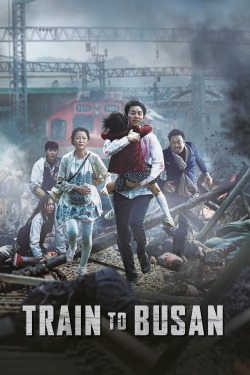
Review of Train to Busan (2016) by Khoi N — 03 Jan 2017
Sometimes it's all about the message. The plot is extremely straight forward- just imagine yourself commuting to work every morning in subway but instead of fellow human commuters, you have to share seats with decaying zombies suffering from clinical level of neck fetish.
The film opens up with a conversation between a guard dressed up in a hazmat suit placed at the check- post of Jinyang County and a disgruntled farmer who, skeptical about the appearance of guard, fears that his livestock might, again, be subjected to euthanasia. We learn from the guard about a "minor leak at biotech district" to which the farmer responds with a ridiculously hilarious slang, of which I am not sure if it's a thing in South Korea or my English subtitles were incorrect. A moment later, truck driven by the farmer collides with a deer and we assume of its death by the look of it. Our expectation comes true when the presumably dead deer resurrects with a new zeal suffering only a minor zombie-infection of which the leading zombie-doctors diagnose as "white-eyes-staring-at-your-soul syndrome". After all, why should monkeys have all the fun? (28 Days Later (2002)).
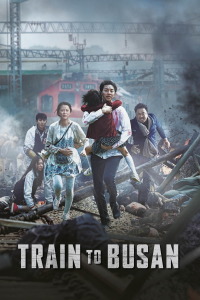
Enough of Jinyang, we now travel to Seoul where we are introduced with a divorced fund manager, Seok-Woo and his estranged daughter Su-an. It seems that divorce has taken its toll on the child. The only gift that Seok-Woo knows of is Nintendo Wii which he gifts his daughter on every occasion whether it be her birthday or Children's Day. We learn that Seok-Woo could not attend the poem recital of Su-an. The scene in which Seok-Woo looks, regrettably, at the recorded video of poem recital by Su-an subtly infers two things - it illustrates frustration of a loving father who has to sacrifice the present in order to secure the child's future and it also illustrates frustration of a young child unable to celebrate her small but valuable moments and accomplishments with her father. The poem recital incident, though, trivial is saving its impact until later. Su-an, an adorable and spirited child, says she, alone, will travel to Busan to meet her mother in case her father has more important work to attend to. Fearing that he might estrange himself from his daughter, Seok-Woo agrees and they board the KTX, which is also occupied by the tough working-class husband Sang-hwa and his pregnant wife Seong-kyeong, a high school baseball team, rich but selfish CEO Yon-suk, elderly sisters In-gil and Jon-gil, and a homeless man. As the train departs, a spasming young woman boards the train with a bite wound on her leg.
Even though the movie explores a frightening incident - zombie apocalypse, it is not devoid of humor. Director Yeon Sang-ho refrained from slapstick comedy as seen in Shaun of the Dead (2004) and resorted to a more refined yet extremely effective humor. The incident where a passenger named Sang-hwa, a tough working class man, tells Su-an to find another washroom because the one he is standing before is occupied by two persons made me wonder, as confused as Su-an was, how can two persons use a washroom at the same time unless something gamy is happening inside and "Train to Busan" was not that kind of movie. Moments later, when I realized he was talking about his pregnant wife and by "two persons" he meant his wife and unborn child, I could not help but laugh at my imprudence. The film employs plenty of these innuendo humors to balance out the chaotic atmosphere. Cinematographer Lee Hyung-deok employed a disciplined approach to camera work and opted slow-motion effect, zoom ins or erratic motions only when the situation really demanded for it. That way, we feel the dread or terror only when director intended to be felt and not during the scenes when atmosphere was mellow or thought provoking. The film also aims at exploring the political landscape surrounding the incident. The brilliantly portrayed scene wherein the telecast inside the train states the event (full-scale zombie epidemic) as just another riot and that citizens are urged to refrain from reacting to baseless rumors of zombies, illustrates how media and those charged with governance propagate their agenda instead of owning up to the responsibility. The scene is as beautiful as a poem when the words of telecast is combined with the images of a woman turning into a zombie creating a contrast between what is said and what actually is.
There are moments in the film which exhibit exemplary heroism, audacity and altruism. The scene where the three protagonists- Seok-Woo(the fund manager), Sang-hwa( tough big man) and Yong-guk(Baseball player) fight their way against hundreds of zombies from train compartment nine to compartment fifteen to rescue people can inspire even the most feeble ones into becoming the valiant. There are also moments in the film that exhibit dastardliness and extreme self-regard. If I were to choose between my own/ family's safety and safety of someone whom I don't even know, whom should I choose? "Train to Busan", superficially, clearly distinguishes between the protagonist and antagonist but if I were there and had to introspect regarding what would I do in such circumstances, I really couldn't say. The film has two polarizing characters, Sang-hwa (a tough working class man) and Yon-suk (the old CEO). They stand at the opposite ends on either side of "selfish scale", if there was one. Sang-hwa does not seem to have even an ounce of selfishness in him while Yon-suk, at times, would put even Nero to shame. I am angry at Yon-suk. But is my anger justified? Zombie Apocalypse is very far from even the most unusual of circumstances we would ever have to encounter in our lifetime. If history has taught us anything, it's that -the definition of humanity changes along with the convenience. No one batted an eye or even uttered a single word against Yon-suk when his actions were in their favor.
Sang-hwa, on the other hand, is the emblem of altruism. In most of the films, the lankiest or the not-so-good-looking fellow would normally be the funniest one but in this film, the biggest fellow is the funniest one. All the humor in the film revolves around him and ends with him. He is the heart of the movie. He represents of old-school heroism. He is big-he needs to be because he has to block hundreds of zombies. He is humorous - he needs to be otherwise people would lose hope. He is brave-he needs to be for no one else is.
The best thing about the film is that it keeps you at the edge of the seat. You keep on biting off your nails contemplating if someone would commit any mistake inviting havoc to themselves. The thrill is not in seeing a horde of zombies desecrating someone but in the anticipation of desecration itself. Director Yeon Sang-ho spends just the right amount of screen- time with zombies as with humans. Even though the film belongs to zombie apocalypse genre, it is not about the exploits of zombies but Its essence, rather, lies in portraying what people do in the most unusual of circumstances. The film ends with an answer to a question- What makes us human? It would be a sin to describe the sequence at the end. It must unfold as a surprise for you. Aloha 'Oe!
This review of Train to Busan (2016) was written by Khoi N on 03 Jan 2017.
Train to Busan has generally received very positive reviews.
Was this review helpful?