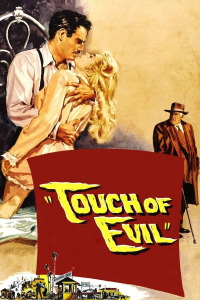
Review of Touch of Evil (1958) by John P — 12 Apr 2011
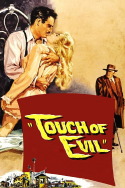
Charlton Hesston playing a Mexican. I must admit, I was highly skeptical at first. Sure, he's played roles ranging from Moses to a British tea planter to the last human in a world filled with vampires. But in all those movies, he was clearly white. And yet, in this movie, casting Hesston in the role of a Mexican narcotics agent actually works. But on reflection, how could it not, considering that Touch of Evil was made by Orson Welles himself.
Welles is, after all, the man responsible for Citizen Cane. Hearing that he's connected with a project tends to raise expectations- especially when he both stars and directs. And Touch of Evil more than meets them. Here we have a web of lies and conspiracy that keeps you guessing, rapidly building tension in the second half, and two legendary actors giving some of the best performances of their careers.
Hesston plays Vargas, who along with his American wife is celebrating his success on his last case. Their border vacation is cut short when the car ahead of them explodes in a massive fireball. Every law enforcement officer in the county is soon on the scene, including Captain Quinlen (Welles). He makes it clear from the start that he doesn't want some Mexican getting involved in his affairs, but the bomb was planted in Mexico, probably by a Mexican. Plus, Vargas may have more personal reasons for sticking around, possibly involving the local crime boss. It's clear that these two will but heads and work at cross purposes all through the case. But when Vargas that Quinlen may be planting evidence, the film takes a whole new direction. Both men's reputations are at stake, and there will be no holds barred.
For those of you still reading, I cannot fully express just how great Welles' screenplay is. Rarely, if ever, predictable, it keeps you guessing as to the characters' intentions, motivations, and connections to each other. Deals are made and loyalties shift, with the other characters- and the viewers- only gradually becoming aware of what's really happening. It also must be said that nothing, absolutely nothing happens that does not tie back in to the plot. There are no fillers here. And at the end, everything is explained, and all the loose ends tied up, without resorting to any Deos ex Machina devices.
Back to Charlton Hesston. If his name had not been in the opening credits, I would never have guessed that it was him. He looks nothing like himself; he looks Hispanic. This film must have had one hell of a head makeup artist. Of course, the fact that it's in black and white doesn't hurt. I doubt this would work nearly as well in color. And yet it's not just his appearance. He speaks Spanish like a native, and has the subtle hand gestures down pat. The only thing that leads one to suspect he's white is that he also speaks English like a native- that is to say without a noticeable accent. But as convincing in his portrayal as Hesston is, his is only the second best performance in this picture.
Warning! Major spoilers ahead!
Besides providing excellent writing and direction, Welles also gives us one of the most loathsome characters in the history of cinema. Physically he's overweight, with a homely visage. His movements are slow and plodding, and his voice a low growl mixed with a smoker's cough. From the moment we first meet him, it's obvious that he's a racist and a bigot. It also becomes clear as the movie progresses that he is seriously corrupt, to the point that his career and the reputation he's built for himself are based on blatantly illegal acts, acts which have led to the deaths of possibly innocent people.
For Quinlen, his job isn't about seeing justice done OR following the letter of the law. It's only about clearing the books and seeing that someone is punished. And he will do anything, no matter how unspeakable to keep his sterling reputation intact. And it doesn't matter how long or how loyally you've served him, he only cares about himself.
The final scene, with the wiretap, is an absolute masterpiece of high tension. At every second, the hero is threatened with discovery. Quinlen is a smart man, even drunk. The conversation between him and the sergeant can only go on so long before he realizes he's being set up. We know this, and the question becomes "Can Vargas keep him in the dark long enough to get what he needs?" When this question is answered, the final confrontation is masterfully handled. It is upstaged only by the coda, in which the original case is solved, and we discover just how pointless all of Quinlen's schemes were.
This review of Touch of Evil (1958) was written by John P on 12 Apr 2011.
Touch of Evil has generally received very positive reviews.
Was this review helpful?