Review of Tokyo Sonata (2008) by Dániel V — 04 Apr 2009
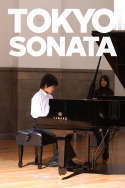
Right now, Japanese cinema is at its best since the 1950s, when legendary filmmakers Akira Kurosawa and Yasujiro Ozu were in their prime. A Japanese film, Departures, won the Academy Award for Best Foreign Language Film less than two months ago, and with his most recent effort, cult-horror director Kiyoshi Kurosawa (no relation to Akira) has delved into the realm of urban drama for the first time. The result: the refreshingly original, eerie thriller Tokyo Sonata.
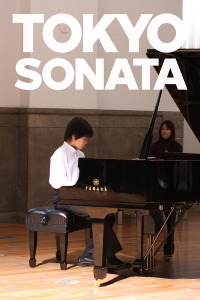
The film's title is the result of its setting: in Tokyo, the Sasaki family experiences a series of four interspersed stories--sonata-like--one from each of the four main characters: the mother, the father, the elder son, and the younger.
We are first introduced to Mrs. Sasaki, a housewife who always seems aware of, yet also detached from, her surroundings. The first scene shows Mrs. Sasaki quickly shutting the front door of her well-cared-for home, wiping dry the floor that has been soaked by the rainstorm outside, and then reopening the door to stare at the forceful torrent soon to arrive. An example of Kurosawa's directorial touch, which he's exhibited in his scary Cure (1997) and his multilayered Pulse (2001), the opening sequence sets the tone for the rest of the film.
Portrayed effortlessly by Kyoko Koizumi, Mrs. Sasaki is perhaps the most complex character of Tokyo Sonata, as it is not until the final third of the movie that we begin to understand fully her relationship with her family and her understated discomfort in her domestic situation. In a way, Mrs. Sasaki serves as the focal point for comprehending the lives of her husband and sons.
Mr. Sasaki, the self-aggrandizing patriarch of the family, finds himself displaced from the administrative director position he holds at a medical equipment company, which has recently outsourced his branch to China. Unable to muster up the courage to tell his wife of his unemployment, Mr. Sasaki spends much of his time with another man in his same situation, standing in line for job advice or for free food in the park. Without doubt, our current economic crisis makes Tokyo Sonata all the more palpable, and Mr. Sasaki's paranoid embarkation into the depths of embarrassment and shame appears frighteningly real.
Life is simpler for Takashi, the Sasakis' elder son. He works late nights, handing out promotional tissue packets given to him by advertisers, only to return home sedate and longing for his bed. A sound-bite Takashi sees on the news, though, piques his interest in the U.S. military--it is now allowing foreigners to serve in the army. So, Takashi decides to go abroad and "fight to protect the family.".
For all the relative simplicity of Takashi's life, then, the life of his little brother, Kenji, is most complicated. He is clearly more mature than are his peers, and he possesses a keen interest in piano that his father denounces from the start. Kenji bypasses parental consent and uses his lunch money to pay for piano lessons; his teacher, after guiding him for a month, she tells Kenji he has a natural talent--that he is a musical child prodigy--and should apply to a special, music-focused secondary school. Knowing that his father will seethe with anger if he brings up the topic, Kenji tells his teacher it's an impossibility.
What makes Tokyo Sonata most interesting is its ability to seamlessly enmesh the stories of all four Sasakis, each with his or her own issues and idiosyncrasies, into a multifaceted web of visual exuberance. The film's music, a beautiful blend of modern and traditional sounds, serves the plot well, and while its final thirty minutes are a tinge short of absurd, the movie is indeed a colorful chronicle of economic hardship, family dynamics, and the human condition. B+.
This review of Tokyo Sonata (2008) was written by Dániel V on 04 Apr 2009.
Tokyo Sonata has generally received very positive reviews.
Was this review helpful?