Review of Three Identical Strangers (2018) by Bertaut1 — 10 Dec 2018
Interesting and reasonably well-made, but morally questionable in how it presents some of the material.
What is the primary factor in making us who we are? Were the truly great figures of pure evil - Elizabeth Báthory, Adolf Hitler, Harold Shipman, Peter Scully, Adam Sandler - always destined to become who they became, or are there to be found moments and influences in their environment which turned them into the monsters with whom we're familiar? Is our destiny genetically encoded at the moment of our conception? In short, it's the question of nature vs. nurture. Focused on precisely these questions, twin studies attempt to determine the etiology of differential psychologies in individuals who are genetically similar.
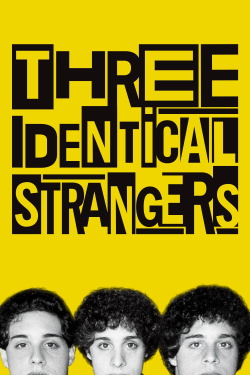
And these are the murky waters charted by director Tim Wardle's Three Identical Strangers. However, for me, although the fascinating central story is undoubtedly gripping, there are just too many egregious problems, including an excess of distasteful sensationalism; a dearth of contextualising scientific information; overly simplistic ethical, moral, philosophical, and esoteric conclusions; stylistic drabness; and, an overreliance on plot twists beyond what you would expect of a documentary.
The film tells the story of Bobby Shafran, Eddy Gallan, and David Kellman, who, through luck and coincidence learn they are triplets separated as babies. Becoming minor celebrities, they appear on talk shows across the country. However, they and their families are puzzled as to why they had been separated, and why their adoptive parents had not been told they were triplets. Was it a coincidence that Bobby had been placed with an affluent family, Eddy with a middle-class family, and David with a blue-collar family? Did the regular aptitude and psychological tests they received as children, part of what their parents were told was a "routine childhood-development study", have anything to do with their separation? What was the involvement of the Jewish Board of Family and Children's Services? How much did Louise Wise Services know? How was Dr. Peter B. Neubauer of the Jewish Board's Child Development Centre involved? Where was the birth mother?
As to the question of nature vs. nurture, initially, events seem to point very much to nature - the brothers smoked the same brand of cigarettes; they had been amateur wrestlers; they had the same taste in women; they had similar speech patterns. However, as the documentary goes on, the argument shifts, with the brothers admitting they over-emphasised their similarities at the time, leading to what seemed a clear win for biological determinism. As time went on, however, their differences began coming to the surface, and ultimately, the documentary argues in favour of nurture.
However, how it goes about establishing this argument is questionable, with Wardle sliding more and more into sensationalism. So intent is he on controlling our perceptions that he leaves out a massive piece of information until such time as he deems it pertinent to reveal, and when he does so, he explicitly tells us what to think about it. It's difficult to go into any of this without straying into spoilers, so consider the rest of this paragraph a spoiler. Essentially, Wardle paints the suicide of one of the brothers as unquestionably the result of his adopted father's disciplinarianism, a father who is still alive, and who appears in the film. Wardle does this by cutting from a clip of that father wondering if he had a role in the suicide to one of the other brothers saying, to paraphrase, "I'm still alive because my parents weren't as strict as his." Blaming his death entirely on parenting in this manner is facile, grossly overly simplistic, and offensive. In fact, the way Wardle handles the suicide in general is deplorable, teasing it and teasing it, before gleefully revealing it for maximum tabloid-esque shock value.
There are other problems, however. Aesthetically, the documentary is drab and dull, almost lifeless. The recreations are bland, and the talking head interviews are flat. Additionally, twin studies are a recognised and accepted scientific practice, but Wardle is so intent on making sure we are appalled at what happened to the brothers that he provides almost no context. If he had spent less time trying to steer the viewers' emotions and more in providing a broader theoretical framework, the film would have worked much better.
The story of Three Identical Strangers poses fascinating questions about nature vs. nurture and the morality of certain types of research, but Wardle's subjective opinion comes across far more than it ought. More interested in driving home the shock value than providing a penetrating documentary about free will vs biological determinism, there is little here that you wouldn't be able to find on Google. Given the outrageousness of the material, that Wardle has made such a conventional film is disappointing.
This review of Three Identical Strangers (2018) was written by Bertaut1 on 10 Dec 2018.
Three Identical Strangers has generally received very positive reviews.
Was this review helpful?