Review of Threads (1985) by Bill K — 22 Jul 2008
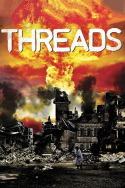
Grim 1980s vision of the escalating conflict between the US and the Soviet Union over Iran. It leads to worldwide nuclear holocaust, and we get to experience the apocalypse largely through following members of two families. As any film that seriously treated the experience of this kind of horror, this one offers no redemption-- at best, a grim return to a medieval stage of humanity that can at least find itself again through labor.
The theme is obviously contained in the title, but the bulk of the film seems to deal with the absence of threads, the massive and sudden disappearance of any kind of imagined social tie with others. Only the strong hand of the tattered remnants of police and military authority offer any real sign of social "threads." Family as we know it has been so damaged by the holocaust that it makes no re-emergence in the course of the human recovery depicted by the film. Is the point therefore that we spend so little of our energy and attention on the threads, the practices that do hold together our social and political institutions? That we have produced institutions that allow us to effectively lie to ourselves about their permanence and self-sufficiency? And of course, all the while, we have produced a military force that can, and could, in an instant, make the world into a burning desolation without even the hope of a dream of such ease among others and in the world. How can these contradictions exist-- this massive destructive force and the utter forgetful ease demanded by social institutions? Is today's answer, now that the specter of Soviet socialism has been exorcised, to replace any worry about social institutions with the market, to reassure ourselves that the market is the most powerful and profound kind of social tie-- the most intricate web-- that we could imagine? Do these threads have the strength to hold back military escalation? Or is military escalation no longer opposed to social institutions-- has it not become part of the very weave of our system, a constant escalation designed not with total destruction in mind but a constant military intervention? Can the militarization consume, dominate the market? Or are there still "social" features of the market that are not prepared to admit, just yet, that all business is on the verge of becoming military business?
This review of Threads (1985) was written by Bill K on 22 Jul 2008.
Threads has generally received very positive reviews.
Was this review helpful?