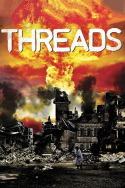
Review of Threads (1985) by Luke S — 19 Oct 2010
It's effortless for my generation to overlook how close global nuclear obliteration must've legitimately felt in the 1980s. We got past the fall of the Berlin Wall and the downfall of the Soviet Union without igniting any mushroom clouds and had those fleeting years of the 1990s that were totally apocalypse-free, and it was like the globe all sighed in relief simultaneously. And even today, the menace of dirty bombs and lied-about nukes, while chilling enough in their own contexts, probably can't vie with jeopardizing all humankind. Give it twenty years, when China and India have fostered widespread consumerism in ever greater amounts in their populations and a couple billion computer programmers and junior marketing execs will all want SUVs and this larger global middle class will be scrapping about dwindling oil reserves, and we might have to lose more sleep over The End Of The World As We Know It again. But not yet.
Director Mick Jackson hasn't managed to create a distinctive style or personal theme to his work. In almost every case, Jackson's direction has been superseded by the participation of someone else, whether it be a stellar cast, the screenwriter or the palette of CGI special effects. But his Threads aired on PBS here in America, and makes The Day After look like The Family Stone. When I say that Threads is one of if not the most horrific, traumatic movie you could ever see with a sociological or political subject, it's merely since it scorches a black gully across your mind that doesn't quickly settle, as it'll afflict the dark alcoves of your mind's eye. A character says, "If a bomb does drop, I wanna be drunk out of my mind and straight underneath it when it happens," and this movie holds absolutely nothing back in showcasing precisely why this is not too radical a stance to take.
Like The Day After, Threads charts an array of everyday people. Threads is set in the industrial city of Sheffield in northern England, in the swelling toward a nuclear exchange between the United States and the Soviet Union. But unlike The Day After, it detonates all charades of movie refinement or sugar-coating, and it puts a documentary-style weight on all the civic arrangements for war, the order of which gives the film a special sort of horror: It implies that our leaders, in their very judicious planning, thought that a nuclear war could be endurable. So while pregnant Ruth and her fiancà (C) Jimmy futilely chafe old wallpaper from the walls of their new apartment, a hopeless endeavor to act as if everything is fine, there's a tidy British composure to hospitals being vacated for anticipated fatalities and workers removing the art from museum walls and an unflustered BBC announcer droning that "the time has now come to make everything ready for you and your family in case an air attack happens." It does, and it's ghastly, from the traumatized woman who soils herself when she sees the mushroom cloud rising over the city to the man trapped on the toilet when the bomb goes off to the cat rolling around in torture in the flames, Jackson and screenwriter Barry Hines induce a down-to-earth and staggeringly realistic authenticity into the film that is utterly etched in. Threads merges traditional plot sequence with documentary-style text screens and narration. One of the crucial essentials of the film is that much of the coverage of world events leading up to the war is in the background, with few people paying attention until it becomes unmistakable that war's at hand.
But the attack's just the beginning. The very very effing beginning. The film's title denotes the precious value of inter-reliance in society, and how a nuclear war can unstitch these bonds. Threads begins with alternating shots of a spider weaving its web and of power lines running over Sheffield, as the narrator indicates how interrelated humans' lives are in modern urban society. In the early bombardment of the war we see command and control centers dislocated, then next the devastation of cities as more missiles hit. Law and order disappears, then people seemingly stop caring for one another, likely because of large-scale post-traumatic stress from what they've undergone. In due course, deep-seated elements of human society, like language, have deteriorated.
The government's provision for nuclear war is unfeasibly confident, and mayhem and pandemonium soon rule. Threads follows Ruth (and the child her unborn daughter becomes) in the weeks, months, and years after the war, and among all the piercingly sad prompts of the small stuff that have vanished evermore, from eyeglasses and cigarettes to video games and paperback books, and some of the most shocking images I've ever seen on film. Medical condition in what lingers of one hospital dare explanation, except that I still have stains in my underwear from seeing the hospital sequence. It's a severe portrayal not just of the end of civilization but the beginning of what will supplant it, and why the dead really are the lucky ones. The vacant gazes of overwhelming disbelief on the faces of the "survivors" in the wreckage are dreadful enough. But as England is, over 13 years, relegated to dark-ages degrees of provisions and crude, basic endurance, the untamed primitiveness of this new world's children, the ones born into it, who've known nothing else, is something one must never, ever be allowed to forget.
This review of Threads (1985) was written by Luke S on 19 Oct 2010.
Threads has generally received very positive reviews.
Was this review helpful?