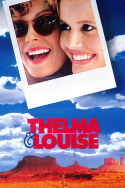
Review of Thelma & Louise (1991) by Reel H — 11 Jul 2013
SCOTT: Greg, once again we go back in time, more than two decades ago, to visit a classic movie that has had considerable impact on both society and the movie industry.
GREG: Thelma and Louise - a sort of Butch Cassidy and the Sunshine Kid, only in modern times and with women in the lead roles.
SCOTT: Exactly. At the start of the film we are introduced to two women who have been beaten down by the men in their lives. Their names are Thelma Dickinson (Geena Davis) and Louise Sawyer (Susan Sarandon). Louise suggests to Thelma that they go on a short 2-day vacation to get away from the insanity of their lives. Terrified of her husband's reaction to such a plan, Thelma avoids telling him and packs up and leaves with Louise. The two women drive Louise's convertible Thunderbird down a long country highway toward more of an adventure than they bargained for.
GREG: They stop for a night of drinking and dancing at a dive bar. A local man takes an interest in Thelma and feeds her beer and dances the night away. Unfortunately, he feels she owes him something and attempts to rape her in the parking lot. Louise intervenes and shoots the man. Now the women are on the run.
SCOTT: Greg, I hadn't seen this movie in more than two decades. It's aged well. Davis and Sarandon deliver memorable performances as they navigate from one dangerous, disrespectful male to another. We are witness to the hideous treatment they receive from the men in power all around them. It's an ugly sight and as viewers we can't help but sympathize with them.
There are several nice subtle touches to drive home the film's message of male oppression and how women have been affected by it. There is a sense of hopeless resignation everywhere during the first half of the film. Faces of random older women with defeat in their eyes are shown between scenes. Gradually this sense of desperation changes as Thelma (and to a less extent, Louise) become transformed over time.
GREG: This movie reminds me of Butch Cassidy and the Sunshine kid. In both movies we have heroes who are working outside the law. They are running from the authorities and they end up tragically.
The big difference in Thelma and Louise is that our heroes are on the run for reasons outside their control. They start out as victims, then they take control.
First there is the attempted rape against Thelma. Then the cowboy (Brad Pitt) steals their money. This is when they go on the attack. After being victimized by men, they take control. Thelma holds up a grocery store. Then, when a state trooper pulls them over, they lock him in his own trunk. When a trucker makes crude advances on them, they blow up his tanker truck.
SCOTT: It takes Thelma a little more time to seize control of her life than it does Louise. In a way, Louise serves as a mentor to Thelma. The overall story arc follows a nice progression. At first Thelma and Louise are trapped in a "damned if you do, damned if you don't" position with the abusive men around them. Gradually they begin to relish their roles as outcasts and masters of their own destinies, even when it becomes inevitable that the ultimate end to their flight is doom.
Slowly but surely, as the film progresses, we begin to see gender role reversals - men who earlier wore bravado on their sleeves are now reduced to sniveling, ineffectual wimps. We know the transformation is complete near the end when Thelma proclaims, "I don't remember ever feeling this awake." Her missing inner quality has been recovered.
GREG: There is at least one decent man in the movie. Detective Hal Slocumb () recognizes that these are two woman trapped in circumstances that simply got away from them. He pleads with the FBI man to slow it all down because "it will all end with someone getting shot." And in the end, the women are chased by dozens of Nevada's finest only to end with our heroes running the car into the Grand Canyon.
SCOTT: I was glad there was at least one honorable male in the film. He can't do nearly enough to save the two women, whom I see as great modern-day tragic heroes. I was also struck by the scene toward the end featuring a Black bicyclist who blows smoke into cop's trunk holes. Clearly, this scene underscores the film's larger message that it isn't just women who are oppressed by white males, but many other groups as well.
GREG: Thelma is the truly transformed hero in this story. She goes from being a timid housewife and victim to being a completely liberated woman in control of her world.
This is a classic yet tragic hero's journey. And one of the few female buddy movies. Thelma and Louise get my highest rating for a great film experience and also for a great pair of heroes. 5 Reels and 5 Heroes.
SCOTT: I agree, Greg. Thelma and Louise is one of those rare films that simultaneously inspires while also portraying a sad sense of inevitable disaster. These two women make choices that, strangely, have us cheering yet also have us questioning their good judgment at the same time. And it's all very believable and powerful.
Some people have questioned the freeze-framed ending of their car caught in mid-air over the canyon. I applaud the choice -- it has sparked great debates and has a potent symbolic meaning that I respect. So like you, I award the film 5 Reels and 5 Heroes.
This review of Thelma & Louise (1991) was written by Reel H on 11 Jul 2013.
Thelma & Louise has generally received very positive reviews.
Was this review helpful?