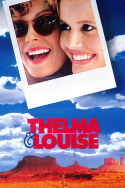
Review of Thelma & Louise (1991) by Jake R — 29 Mar 2009
Ridley Scott had spent the best part of the last ten years making intensely moody, visually extraordinary films but had been criticised frequently for his underdevelopment of any emotional doorway through which the audience could relate to and like any of the characters. To see him, then, work his magic on such a human story, is the equivalent of seeing a Disney directed by Michael Mann. Scott could so easily have focused on his trademark visual wondrousness, but, perhaps egged on by the fact he couldn't create his own articial landscaps like he could in 'Alien' and 'Blade Runner', here he puts his own heart into working through the perilous journey of the title characters. Surprisingly, it works, and turns out to be one of his best pictures, and a welcomely realistic entry into a year obsessed with sci-fi and the supernatural.
Callie Khouri's debut screenplay is a refreshingly naive take on a well-worn genre, with creaking roots all the way back to the early 1940s. It's fitting, then, that a genre traditionally dominated by male presences is reworked half a century later to examine the cause of modern woman. Yes, the film is an intelligently feminist piece but it seems this praise is garnered simply from the title alone. There's actually a much more insightful and informed construction that goes into these various lives, and, crucially, none of the characters are reduced to mere symbolic elements. These women have believeable lives, believeable personalities and, at the end of the day, believeably crummy situations.
Throughout the film's emphasis is not on the liberation of women but on the misery women are subjected to. Obvious examples include misogynistic men and abusive, lacklustre partners, but this contrasts with the brightness and purity of the two women. These aren't saints, but they are people willing to settle for simple lives, where they have the freedom to explore without their men becoming jealous or violent. It's a simple desire but one denied to so many women, worldwide as well as in the notoriously volatile American South. Thelma and Louise are two loving, caring people who just want the best for everyone, but not everyone can appreciate it, and not everyone wants to. Their very odyssey unravels because of the basic prejudice against women as liars and manipulators and how injustice for the little people, the unassuming housewives, the smiling waitresses, gets overlooked much more than is made out to be. But, as mentioned before, these women are not saints, and they, like everyone else, have their own breaking points.
As such, the film darkly eschews the comic mishaps of a road movie to take on a rhythm more akin to a chase thriller, with each scenario forcing the characters to act outside the law if they are to remain alive and in one piece. It's a vicious circle that only emphasises the beginning assumption even more. But these incidents don't go unregistered. Both women come to realise the seriousness of their situation and its consequences, and in the final act display a desperate disregard for hope, refusing to believe anything good can come out of it anymore, and revert to a very primal instinct of just trying to make life worthwhile. Herat-breakingly, it turns out to be each other, and their friendship is a credible, warm-hearted one that tests and strengthens their own faith in each other. The final climactic resolution is one of rare poignancy and simplicity, a paean to the power of friendship, of a uniquely female kind of friendship.
Scott has a sharp mind to shoot the film from a feminine perspective. The women are subjected to the same kind of stereotyping and prejudice from the inhabitants as if they were black, homosexual, disabled, or anything other than an American white male. It's the men who are the untrustworthy partners, the ones who bring little to the relationships. Brad Pitt's 'J.D.' takes on the femme fatale role, seducing his way into Thelma's wallet. Even the police confrontation at the end is softened because they feel women deserve a bigger chance, because they're women. Even this seemingly hospitable attitude lays bare the ignorance of a male dominated society, one still unchanged anywhere in the world after almost 20 years. Khouri's message is for women to not be afraid to rely on each other, and to make good friends instead of competing for attention of men, who mostly don't recognise and return it anyway. It's not a misandric comment. If any of the above conventions were applied to a normal thriler with two male leads they would slip by unnoticed; the fact that they are stripped of Hollywood exaggeration and gloss is what makes Khouri's script so confrontational, so radical, yet so convincing and professional.
Like with most heavy-sounding films, there's a ton of earthy humour. Thelma and Louise never miss an opportunity to diffuse the tension with a wisecrack or soem self-deprecating humour, and it's brilliant to see the two actresses carry it off so skilfully. The film as a whole does hinge on the performances of Sarandon and Davis, and two finer actresses could not have been found for their roles. Sarandon, with her severe face, commands the most knowledge and is the driving force behind the adventure, but is not above wanting to collapse and struggle through a personal emotional blockage once in a while. Davis is the goofier one, her round face and rolling eyes always wringing a smile from the long-suffering Louise, though she has that playfully sexual quality that gets her into so much trouble, though she grows smart enough to exploit it as the journey goes on. Together they seem like they've been best friends for ever and are a genuinely sweet, strong couple. The male cast do pretty well, though they aren't expected to do anything extraordinary. Madsen just manages to convince as a partner who doesn't enjoy beating up his girlfriend for kicks, while Brad Pitt's cocky debut does well to establish that boyish charisma and unabashed flaunting of his masculinity that has become a staple trademark of his career. Keitel has the most interesting male role as the conflicted detective, his sympathy for the women mysterious but seemingly real, though again his own male prejudice gets in the way of the reality of the situation.
Overall, this is a tremendously fun buddy film, fresh, muscular, funny, warm and life-affirming. The two leads are impeccable and, at times, powerfully moving, whilst Scott's calm direction is not entirely devoid of his trademark dust/rain furnishes. Khouri's script amiably ambles from one unfortunate series of events to the next without any tired sign of contrivance, and just the basic, general mood of the film is one of joyous adventure one rarely sees outside of a straight-forward action pic. A classic.
This review of Thelma & Louise (1991) was written by Jake R on 29 Mar 2009.
Thelma & Louise has generally received very positive reviews.
Was this review helpful?