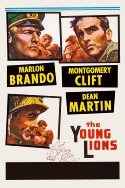
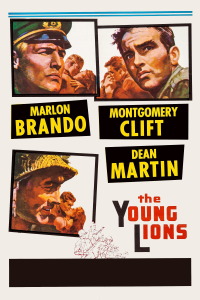
Review of The Young Lions (1958) by Daphne H — 06 Jul 2008
The Young Lions.
Directed by Edward Dmytryk.
Written by Edward Anhalt.
Based on the book by Irwin Shaw.
Starring Marlon Brando, Montgomery Clift, Dean Martin, Hope Lange, Barbara Rush, May Britt, Maximilian Schell.
Based on the Irwin Shaw novel of the same name, this film offers a commentary on the nature of war and its impact in the lives of its fighting men.
Three soldiers are featured and their particular viewpoints regarding war are exploited throughout the film. Lt. Christian Diestl (Brando) is a German Officer who becomes increasingly disillusioned with fighting yet is bound to continue due to his oath to defend the Fatherland. Noah Ackerman (Clift) is a Jewish soldier who suffers severe hazing as a recruit and ends up rescuing one of the men most responsible for his harsh treatment. Michael Whiteacre (Martin) is a broadway musical actor who would much rather be home in production than off fighting an unnecessary war. These three men and their attitudes make up the bulk of the film.
Lt. Diestl believes as the film opens that Adolf Hitler is precisely what is needed in Germany. He believes that the Führer will return his homeland once again to greatness. He?s assigned to the North African campaign and serves his country like a loyal, able bodied serviceman but his heart is not in the conflict and he relishes every opportunity to escape the battlefield and return to at least a semblance of civility.
Ackerman meets Hope (Lange) and a party and quickly decides he is going to marry her. Hope?s father dislikes Jews and Ackerman is obliged to win him over. Ackerman succeeds and a few months before he begins basic training, the couple are wed. She later becomes pregnant and gives birth while Ackerman is stationed over seas. Ackerman enters military life at a decided disadvantage. He is decidedly smaller than the other men and they have all taken a disliking to him because he inadvertently caused the entire unit to be punished. They take to harassing him by stealing his money and ridiculing the fact that he is from New York (and likely because he is Jewish). Ackerman decides to take matters into his own hands by agreeing to fight the four men who have taken responsibility for taking the money and claim they are coming for him. Ackerman is battered in the first three fights but manages to disable the fourth man and begrudgingly watches as he crumples to the ground at Ackerman?s feet. It is clear that the violence he is forced to participate in does not sit well with him. It disgusts him to be involved with such a senseless display of physical bravado.
Whiteacre is essentially, by his own admission, a coward. He wants nothing to do with the prospect of losing his life in a pointless charade and is relieved when he is rewarded with a cushy post in London. Unfortunately, he?s driven hard by a nagging girlfriend named Margaret (Rush) who challenges his manhood and all but forces him back into the fray. He rejoins his old unit just as the war is about to draw to a close.
The film explores war through the eyes of its three male protagonists. In no uncertain terms war is decried and brought to bear as at best a necessary nuisance. Ackerman and Whiteacre are two typical men who get drafted into fighting and are forced to take part in the unseemly carnage of military life. Neither of them are particularly thrilled by their new position but as there is not a whole lot they can do about it, they are forced to follow the call of duty and make the best of it. Ackerman is by far the more noble of the two as he demonstrates heroism on several occasions and proves his merit as a top notch soldier. He takes to the life despite himself and comes out of the war literally with blood on his hands, just like a good soldier should. Whiteacre proves his worthlessness to the order by pushing papers and removing himself from actual combat until his efforts prove all but futile in the end. Whiteacre is the reluctant soldier who shows no real interest in fulfilling his duty and would rather stay as far from the action as possible.
In the heart of Christian Diestl there remains tremendous conflicts about what his proper role in the war effort ought to be. On several occasions he announces his displeasure with the whole process but because of the tenacity of his allegiance to his oath he is unable to fully break away. He disengages mentally quite early on but he is bound to forge ahead as is required of a man in his position. He engages with two women and is possessed of radically different opinions of each of them. Françoise (Liliane Montevecchi) initially chastises him as she blames him for what has happened in France during the German occupation. However, she is drawn in by his charisma and the force of his personality. This leads to a brief tryst but Diestl is forced to separate and return to his duties. Gretchen is the wife of Diestl?s superior, Capt. Hardenberg (Schell). Diestl is asked by his Captain to courier some lace to Gretchen. When he arrives, Diestl is met be a purring seductress who makes a tired play for him. Disgusted, Diestl tosses her aside and storms out of her house.
The acting in this film is quite extraordinary. Marlon Brando is moody and introspective and makes clear that his character is noncommital regarding the war issue through his body posturing and gestures. Brando looks forever as if he is contemplating some impossibly heady set of calculations as he maneuvers himself throughout the course of this film. Every step creates the sensation of a new deep chasm in the very depths of his being. He?s remarkably good at selling the split in Diestl?s consciousness regarding his essential purpose in fighting this war. Montgomery Clift is astonishing as the kicked-about soldier who is forced to express himself physically before he is accepted into his unit. Ackerman is everyman who finds himself at the beck and call of Uncle Sam. With his wife and child behind, his plight is all that more urgent. Clift establishes his character as an honorable man who does what is required of him as it is the only option he can rightfully consider in the end. Clift plays the emotional notes perfectly as Ackerman simply attempts to survive the conflict and head back home to his family. Dean Martin plays it straight and pulls off the difficult character of Whiteacre. This is an upper scale contributor to the arts and he has many reasons not to join in the fighting. Whiteacre lands a sweet gig that keeps him from the front lines and Martin conveys his attitude toward the prospect of fighting quite effortlessly.
Hope Lange is quite lovely and genuine as Ackerman?s girl. She doesn?t have a great many scenes in the film but she conveys the dutiful wife and mother without succumbing to too much sentimentality. Hope is clearly representative of all the wives left behind as their husbands try to avoid coming home in body bags. Barbara Rush plays a straight talking society woman who will hear nothing of any excuses Whiteacre may have to feed her about his reluctance to risk his neck for his country. Rush gives off an intense vibe as she plays her character with a biting urgency that all but swallows Whiteacre up and threatens everyone around her as well.
Overall, this film investigates the war machine from several subjective angles. It allows the viewer to jump into the skulls of three very different men and come away with a relatively uniform understanding regarding the myriad complexities that are a part of every war effort. It isn?t simply an anti-war film. It?s also a deeply introspective examination about the reasons why certain individuals, who can be taken as representing large sections of the whole, feel they are fighting. What?s the purpose of putting one?s life repeatedly at risk? In the case of Diestl, the question might be phrased: what is this war doing for and to my homeland? Is it a just war? More questions arise than answers and this is a tribute to the excellence of the film. Ultimately, though, it comes down to the performances and in this case they all succeed in expressing various emotional aspects of each character as they attempt to make sense of senselessness.
This review of The Young Lions (1958) was written by Daphne H on 06 Jul 2008.
The Young Lions has generally received positive reviews.
Was this review helpful?