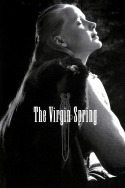
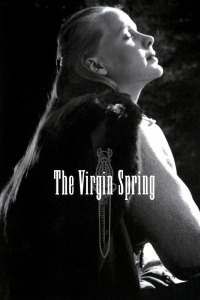
Review of The Virgin Spring (1960) by Michael C — 11 Jun 2009
I have always maintained the opinion that film is often at its best when it can express more when it has sparse dialogue and instead relies on the presentation and the expressiveness of the images to relate the broad palette of emotions that the viewer may identify with.
One of Bergman's finest qualities is his ability to craft films that are light on conversation but are so rich with kinetic action, placement of shots, symbolic representation, and general emotive gestures that it tells the story much better than words would be capable of doing.
This tale, relating the violation and murder of a young girl, the vengeance of her father for the action, and his request for redemption for crossing a very violent line is tied together in a story just under an hour and a half that feels like it tells much more in that brief time than it should be capable of.
Bergman has a talent for taking this human, personal stories and using them as a template through which he can ask some very compelling and difficult questions. What is God's role in the face of tragedy? And are some tragedies necessary for the salvation of others? What is the appropriate action for a grieving parent to take against his childs assailants? None of these questions are answered bluntly, but viewers likely will have a clear idea as to what the implied answers from the film are.
Ultimately though, the film is about the power of guilt; the guilt that a jealous sister has for her younger, more puritanical sibling; the guilt a murderer is haunted by when having to stand in judgement with the parents of their victim; the guilt of a father horrified by an unforgivable crime, who wants forgiveness for taking the only action he felt he could take to make amends for the atrocity.
All of this is magnified by Bergman's magnificent direction. He knows just how to place the camera on the face of his actors, and allow their reactions to say entire brilliant monologues of pain, fear, and panic without a single utterance.
This was the film that inspired Last House on the Left, and while I think that is a very strong horror film, The Virgin Spring is an infinitely better film. Not only did it catch the horror of the events at hand, but it also successfully illustrated the beauty that can emerge from even the most painful tragedy.
This review of The Virgin Spring (1960) was written by Michael C on 11 Jun 2009.
The Virgin Spring has generally received very positive reviews.
Was this review helpful?