Review of The Virgin and the Gypsy (1970) by Steve C — 02 Jan 2017
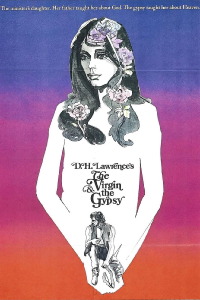
The story concerns Yvette (Joanna Shimkus) a young woman who returns to Northern England with her sister after being in France. It's a period piece, like the 1920s. Yvette's daddy is the local vicar, preacher guy, with a preacher collar and all. He is no longer married to the mother of the two girls, there was a divorce for some reason, not explained or talked about, if it was I missed it. Anyway, there is a substantial stone house out in the ruralness where preacher daddy lives with step-mama and elderly grandma who is kind of a cranky pain being hard of hearing and demanding and such. The family is all provincial morally and basically Yvette is not having it. There is a joyride through the country in a very nice big 1920s convertible automobile with some local, wealthy frivolous youth, one of the boys, we have been informed, adores Yvette, but she's not interested in his wealth or him. So the boys are singing songs of the day and such, being flirtations. They are on a picturesque country road, rolling green hills, and come upon a slow moving horse-drawn cart in the way. So there is horn honking and the dark man in the cart turns around and glares at them.
Enter The Gypsy (Franco Nero).
He saunters back to the car and invites the party to come get their fortunes told. The girls want to go, the boys grumble but go along. We go to a gypsy wagon with a few kids around. The woman comes out of the wagon and she and the gypsy have a quick but noticeably passionate kiss right there in front of everyone. These people are clearly earthy, sort of wild, but in touch with the elements.
Anyway, there is a good deal of suspense from there on through the movie. There is a lot of conflict with the staid family and their buttoned down ways. and some scenes of the contrast between that and the gypsies. All this leads to a very satisfying climax where the stiffness that holds back the power of nature finally breaks down and the natural forces take over with destructive cleansing passion.
I found myself reflecting on the time on the production, 1970. The movie had a substantial hippy, generation gap, feel, D H Lawrence being one of the early 20th century manifestations of this sort of rebellious, erotic passion. Yet, the move, since it is set in an earlier period and not tied to through wardrobe and such to 60s-70s, doesn't so much feel to me like a period piece.
I really enjoyed this movie, actually found it supportive of the element of passion within myself that I sometime allow to be crushed but the stiff walls of the machine.
The time in which the movie was produced was a formative period for me and I know that film product such as this, was critical in forming what I became.
Makes me want to read some D H Lawrence. I haven't in years.
This review of The Virgin and the Gypsy (1970) was written by Steve C on 02 Jan 2017.
The Virgin and the Gypsy has generally received negative reviews.
Was this review helpful?