Review of The Verdict (1982) by Brett W — 14 Nov 2008
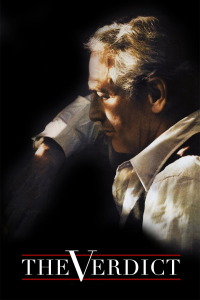
This, the utmost example of people involved in making a film who truly know exactly what they are doing, tells the story of a pathetic alcoholic lawyer, scraping the bottom of the barrel, who presses on with a medical malpractice case, which has left a girl brain-dead in a permanently vegetative state, in order to improve his own situation, but discovers along the way that he is doing the right thing, crusading in the interest of justice for the wronged girl.
Paul Newman is entirely persuasive as the boozing attorney, who beneath his morose impotence is a relentless force. We are surprised by how strict he can be in his behavior and belief systems during the case he takes. He is intently alert, always putting his own needs ahead of any responsibility to others. A lonely man, he stays far from the maddening crowd. For him, life is a burdened practice, not to be wasted away idly, which is precisely what is happening to his life as the film opens, finding him going from funeral to funeral attempting to con the bereaved into believing that he knew the deceased loved ones and wants to make sure they're represented by someone who cares. Every day he gropes drunkenly to apprehend it and wring as much profit as he can.
The reason such a premise works so well is because of the wisdom and mechanics of David Mamet's writing. The internal problem that begins the story, which is an adaptation of a bestselling novel by American trial lawyer Barry Reed, Newman's hopelessness, is succeeded by the external predicament, the highly lucrative case which embodies all the murky details of medical, clerical and legal procedure. Jack Warden, Charlotte Rampling and James Mason are introduced, and our hero Paul Newman finds himself with the decision to fight all- encompassing immorality, for which he is no match, or to accept it, which screams with the practical leverage he needs to get his life back together. He rejects to take the juicy settlement, which compels us into the upsetting second section of the film.
Like many traditional stories after the turning point, this one splits into two parts, the arrangement and the decisive moment at which the outcome seems to be clear. Mamet constructs his scenes so that they correspond to the arrangements for the trial, juxtaposing the enormous legal cart James Mason is mounting, under whose wheels devotees would throw themselves to be smashed, counter to the disorganized, hit or miss undertaking Galvin's running. Characteristically, the stronger the opponent and the weaker the hero, the more pungent the drama and the more severe the ascending friction.
At the point at which things are at their lowest, the scenes have amassed in a callous, inescapable direction. The only element that seems to come from left field is the signature Mamet revelation, which is held back from Newman but not from the audience. It's delicate letting the audience ahead of the hero, because it takes the big chance of making the hero out to be misunderstood by us as stupid, but Mamet had no other place to set the scene, one that if you are familiar enough with his work can clearly see that he could not help but use, and skillfully uses it to make things seem even gloomier to us than they do to the protagonist. It generates sympathy for him, not condescension.
The Verdict is a tribute to classic structure, which determines that character is plot. Ideally, if you're going to have a character arrive on the scene in a story long enough to tell someone how to go to the bathroom, this individual had better be full enough that we can almost assume where they were before the story happened upon them.
Not one scene is needless or redundant. It is film composition at its most succinct, with each scene leading crisply and unavoidably into the next with a story development that is hardnosed in its importance. Sidney Lumet's old-fashioned sense of being a movie director has served him well, especially early in his career, as he hides the presence behind the camera and manipulates what is in front of it and how long it takes to show it. He leaves the gist of things to the screenwriter. His masterpiece Network was one of the few films one can truly say was a writer's movie. Frankly, I think The Verdict is also a writer's movie, because Lumet's perspective of film direction is letting the writer create the story so that the director can tell it.
A true testament to this is that Lumet conserves the essential task of a movie, a succession of images contrasting so that the difference between them triggers the story to broaden within the position of the viewer. Once we get the point of a scene, whether the action within it is finished or not, the film moves on. This is precisely what Mamet would come to do when he began directing his own films.
This review of The Verdict (1982) was written by Brett W on 14 Nov 2008.
The Verdict has generally received very positive reviews.
Was this review helpful?