Review of The Train (1964) by Harry W — 02 Jan 2016
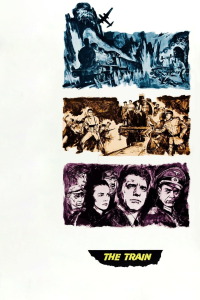
As a sucker for a good war film and a fan of John Frankenheimer's work, The Train sounded like a classic war thriller.
The promotional material for The Train suggested not only that the film would be in black and white, but that it would also be an action-heavy feature. With John Frankenheimer having a distinctive style for car chases and practical action scenes, this simply contributes such an expectation to The Train. Alas, it is unfulfilled. Perhaps I should have been more considerate of the standard for filmmaking that came from the era The Train was produced in, or perhaps I shouldn't have been misled in the first place. Either way, The Train is not the war film I was expecting but rather a thriller set within a war context. It had a story to tell, but it didn't cater to my expectations which affected my experience for the worse.
The Train's plot device consists entirely of its titular vehicle being pursued by protagonist Paul Labiche in an attempt to prevent French artwork from falling into the hands of the enemy Germans. There is a lot of potential here to explore the meanings behind a whether this is the basis of country's desire to protect its own culture or simply as a battle of territoriality with enemies of the war. Unforatunately, this material is barely even hinted at until the film draws to a close and the message that it was apparently intending to convey the entire time is bleakly stated by one of the characters.
The problem is that The Train isn't the war spectacle you might expect since its focus is very small in scope, yet it is hardly a character driven one either. There are allusions to potential for exploration within the primary protagonist and antagonist in the film as explored during the monologue delivered by Paul Scofield at the end of the film, but most of the time the characters are simply supporting figures who come and go at a fast pace. Unfortunately, the film itself does not keep up with this pace and instead drags its narrative out for beyond two hours without supplying sufficient drama in between. The conversations had by the characters are hardly insightful pieces of dialogue and the few action scenes in the film are highly sporadic, essentially just piling on words that prove to oscillate between meaningless banter and actual narrative progression.
However, John Frankenheimer's role as director is an asset which cannot be denied. Though The Train didn't end up as I expected it would with him in the director's chair, you can clearly see that he has put some tenacious effort into the maximizing the production values of The Train. With flawless scenery and set design, The Train easily captures its intended era while the black-and-white helps to add this feeling. The cinematography that captures it all does so in a very high-definition quality, ensuring that the feature is nostalgic yet not dated. The cinematography manages to capture everything from an atmospheric perspective, manipulating angles cleverly and even making occasional use of the Dutch Tilt. Everything is tied together visually, and the sound effects making a striking effect during the silent moments of the film which effectively conveys the bleak nature of violence. When this isn't happening, Maurice Jarre's musical score is adding a gentle touch of life to the film. From a technical perspective, The Train manages to find organic life in the visual and auditory fields, even if there is a feeling that it betrays its potential to rise up and become more of a spectacle.
The other key role in the production is played by Paul Scofield in his performance as antagonist Col. Franz von Waldheim. The entire film, Col. Franz von Waldheim is not characterized as being some kind of sadistic villain but rather just a petty thief who is very territorial about the artworks he possesses. But when the film finally draws to a climax, we see the true endeavour of his characterization. Despite such neglected potential, Paul Scofield remains dedicated to his role the entire time and never drops sight of his exact intentions. When the film finally draws to its final climax, Paul Scofield reveals everything audiences need to know about the character as a person. He speaks with such a tenacious grip on his words, going beyond everything else he has said so far and truly delving into the deep extents of wisdom that have been buried beneath a straightforward Nazi edge in everything leading up to it. Paul Scofield doesn't take the strongest stand until around the time The Train draws to a close, but that is the moment that he truly shines with a nature of both wisdom and charisma. At that moment, the idea that he is the film's enemy is ridiculous as he speaks with such a desirable passion that the concept of hero and villain becomes lost, and the film finally revelas its true meaning. Paul Scofield nails his role with confident sophistication and keeps himself consistent the entire time.
Burt Lancaster is also a strong presence. Though his character is a rather simplistically characterized hero, the man's natural charms make him a convincing fit for the role, as does his abilities to keep physically charged when facing off enemies with a weapon. Burt Lancaster puts his natural charm into the part and leads the film with the determination of a natural American patriot, effectively capturing the archetype that the film needs and doing it with strong interactivity with the surrounding cast. His final scene with Paul Scofield manages to bring out the best of the intensity in both the actors as they face off with each other.
So The Train benefits from John Frankenheimer's tenacious directorial style and Paul Scofield's intelligent performance, but it fails to live up to its promotional material by maintaining a thin story with underdeveloped themes and few action scenes yet still managing to stretch on for a long time at a slow pace.
This review of The Train (1964) was written by Harry W on 02 Jan 2016.
The Train has generally received very positive reviews.
Was this review helpful?